Tangy Lemon Dijon Chicken

A couple of weeks ago I was drawing a blank when trying to come up with dinner ideas. I had chicken to make, but wasn’t feeling like making any of the usual things, so I did a quick bit of online research, and found this recipe. I read all the reviews and thought it was worth a try. When mixing up the marinade, I tasted it as I went, and decided it needed a bit of honey to balance out some of the stronger flavors. I also reduced the salt – just a pinch will do. And I didn’t have a shallot in my fridge, so I added some toasted sourdough bread crumbs over the top in the final few minutes of baking to add crunch. This dish is quick and easy to make, you can easily prepare sides while it is baking, and it feels fancy and restauranty for a change of pace at our house.

Lemon Dijon Chicken

(Adapted from Karen Tedesco’s recipe)

Serves 4

  • 5 to 6 boneless skinless chicken thighs (about 1 1/2 pounds)

Marinade:

  • 2 tablespoons olive oil
  • 2 tablespoons Dijon mustard
  • 2 tablespoons tomato paste*
  • 1 tablespoon honey
  • freshly squeezed lemon juice from 1/2 lemon (~2 tablespoons)
  • 1 teaspoon dried thyme
  • 1 pinch kosher salt
  • 1/4 teaspoon freshly grated black pepper

Topping:

  • 1 cup fresh bread crumbs
  • 1 tablespoon olive oil
  1. Mix marinade ingredients together in medium glass bowl. Taste as you go and adjust as necessary. This is a tangy sauce, and more honey will temper it.
  2. Place chicken in marinade and mix well. Set aside.
  3. Preheat oven to 425°; the chicken will marinate while the oven preheats. Let the oven get nice and hot, so I say let the oven preheat for at least twenty minutes.
  4. While oven is preheating, you can start a pot of rice, prep some fresh veggies to sauté or steam, etc.
  5. When oven is up to temp, grease an 8″ x 8″ baking dish** and place prepared chicken in the dish in one even layer, smooth side up. Place in the oven on the middle rack and bake for 30 minutes.
  6. Once the chicken is in the oven, heat 1 tablespoon olive oil in a large skillet. Add bread crumbs and sauté for a minute or two, until the crumbs begin to color a bit. Remove pan from heat and set aside. About ten minutes before the chicken is done baking, open the oven door and sprinkle the toasted bread crumbs evenly over the chicken. Continue to bake the chicken for ten more minutes (chicken should bake for a total of 30 minutes).
  7. Remove chicken from oven and let rest for 5 to 10 minutes while you finish preparing rice and veggies***. I like serving this saucy chicken over a bed of rice with veggies along the side. Enjoy!

Notes:

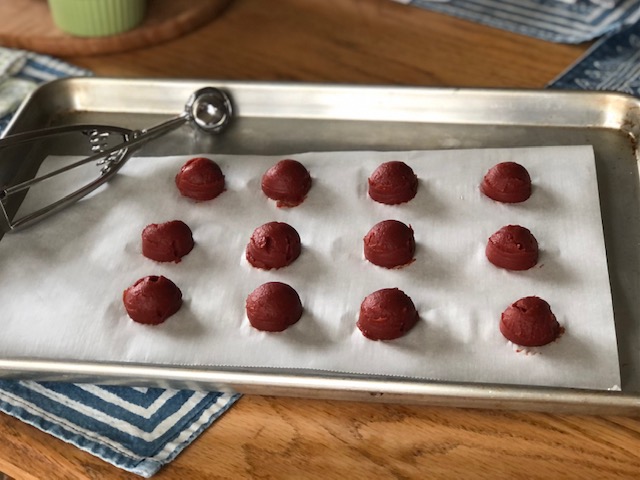
*I scoop out and freeze 1 tablespoon dollops of tomato paste, then keep them in a freezer bag in my freezer for easy food prep. Just zap in microwave for 10 seconds to defrost and use in recipes.

Ready to go in the freezer. A cookie scoop makes quick work of this.

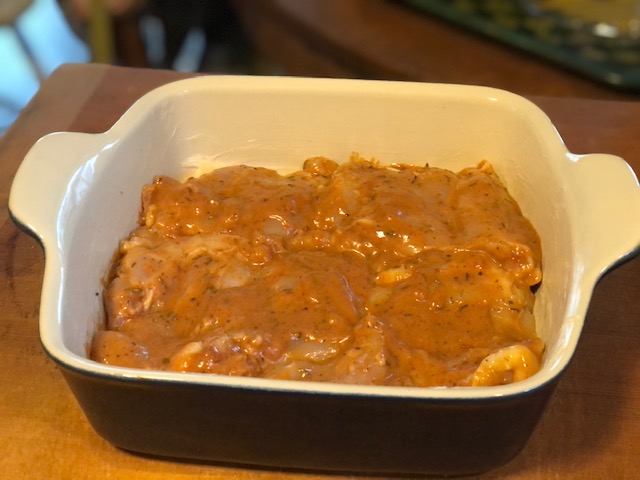
**For the sauce to end up with the right consistency (not too thin and not too thick), you want your baking dish to just accommodate the chicken pieces snugly all in an even layer spread out. An 8″ x 8″ baking dish works really well for 5 to 6 chicken thighs. If you need to double the recipe, try using a 9″ x 13″ baking dish.

Chicken fits perfectly.

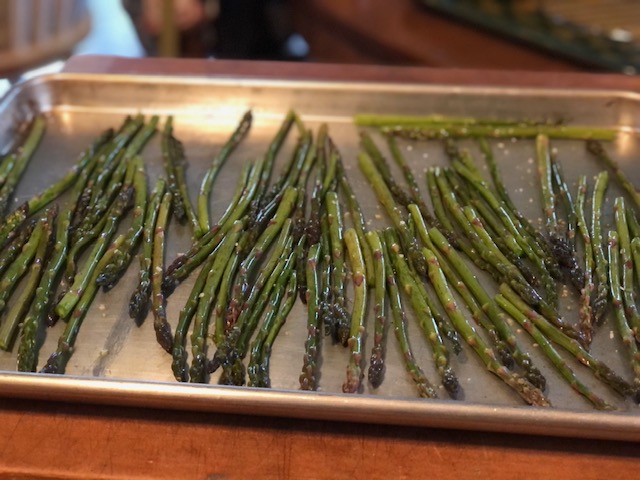
***For a quick veggie side, spread asparagus (or broccoli florets work here too) out on a baking sheet, drizzle with olive oil, toss to coat and sprinkle with a bit of kosher salt. When the chicken is done baking, put your veggies in the hot 425° oven to roast while the chicken rests for 5 to 10 minutes. Everything will be hot at the same time when it’s time to eat, and with minimal effort!

I love oven roasted asparagus!

And just for fun, this is what I’m up against as I try to write this out…

“Helping”


Posted in Busy-day meals, Dinner | 3 Comments

Roasted Eggplant

I absolutely love eggplant, but I am the only one in my family that does. I have gone for decades eggplant-deprived. That is, until I realized I could easily make eggplant and have it as a side dish, or an antipasto, or add it to individual pasta servings (mine), omelettes (mine), pizzas (mine), or just have it as a snack!

Better than french fries!

I have felt sometimes too lazy to make eggplant, because I don’t like the idea of having to salt it first to let it “sweat”, and then wipe the salt off, yadda yadda yadda. Well, I just discovered that you don’t have to do that anymore! Not sure if this is 100% true, but I read somewhere that the new varieties of eggplant no longer require this tedious step. So once I read that, I looked online for an easy recipe and found this one, from Minimalist Baker.

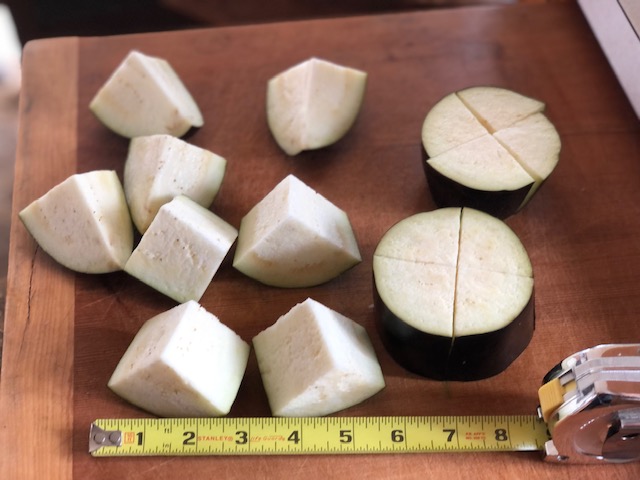
Slices need to be thick – about 2 inches.

It seemed easy enough, and who doesn’t love roasted, caramelized cubes of eggplant? Okay, don’t answer that question. I made the eggplant recipe as instructed, and we were having some guests over for dinner that were vegan, so I thought this would make a nice addition to the table. However, the little cubes of eggplant ended up charred and almost inedible! Funny, our guests still ate it, because apparently I’m not the only one that loves eggplant!

Cut each slice in four.

So next time I made it, I made some changes to the recipe. Mainly, I cut the eggplant into huge chunks! They seem way too big at first, but they do shrink down a lot after baking. Since the chunks were so big, I upped the oven temperature a bit, and the results were just what I wanted.

Toss in olive oil, about 2 to 3 tablespoons – don’t skimp!

I also don’t like trying to toss veggies once they are on the baking tray, so I put the chunks into a large glass bowl to toss with the olive oil.

Sprinkle with kosher salt and spread out on parchment lined baking sheet.

Because the chunks were nice and large, they were easy to spread out on the baking sheet with room between for even browning. My daughter Millie made this one time, and she put all the pieces skin side down to start, and I liked that idea so much that now I do it like that every time!

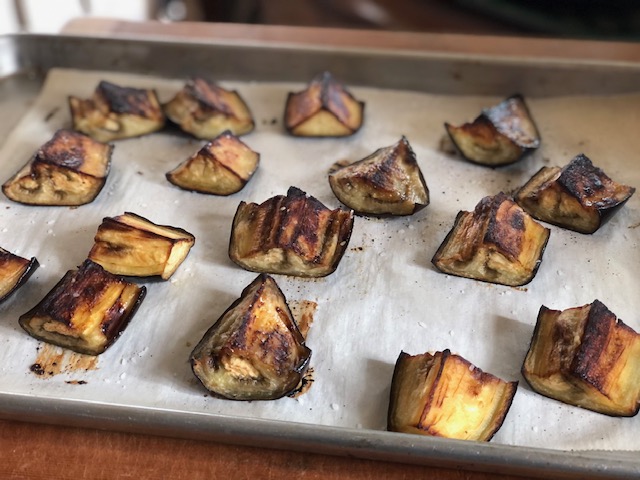
After the first 20 minutes in the oven.

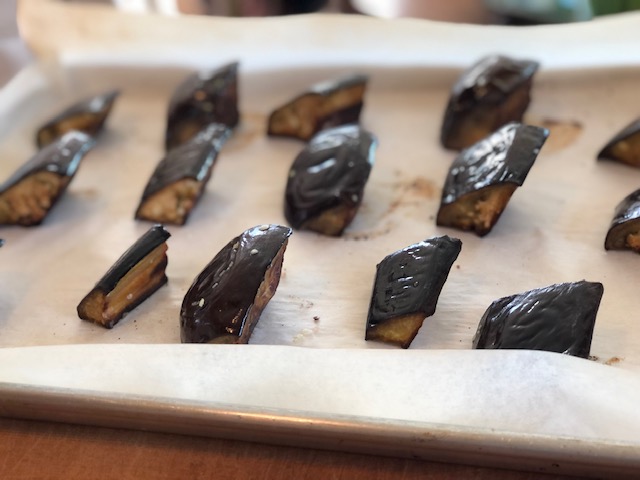
After roasting for 20 minutes in a 450° oven, I flip the pieces over, skin side up, and roast for ten more minutes. What you end up with is so delicious! Warning though, the skin side is a bit tough at first, but softens to a nice chew after a few minutes.

Roast skin side up for the last ten minutes.

I like to keep the roasted eggplant (what’s left of it) in the fridge so I can eat it at will; it’s good hot, room temp, cold, you name it. I have to make up for lost time, you see.

Roasted Eggplant

(Adapted from Minimalist Baker’s recipe)

  • 1 medium eggplant
  • 2 to 3 tablespoons olive oil
  • kosher salt
  1. Preheat oven to 450°, and line a large baking sheet with parchment paper.
  2. Trim ends of the eggplant, cut into 2″ thick slices, then quarter the slices. You will end up with approximately 16 large pieces.
  3. In a large bowl, drizzle the pieces of eggplant with olive oil, approximately 2 to 3 tablespoons, and toss to coat. Sprinkle with kosher salt or other type of flake salt, and toss again.
  4. Place eggplant pieces skin side down on lined baking sheet and bake in preheated oven for 20 minutes.
  5. Remove from oven and flip the pieces so the skin side is up, and bake for 10 more minutes. Enjoy as a side dish, as a nice addition to an antipasto plate, or added to pasta sauces or pizzas. To enjoy later, once cool, store in an airtight container in refrigerator.

Posted in Side Dishes, vegan | 1 Comment

Overnight Oats

I’m late to these trends, but I eventually get there. I absolutely love these overnight oats! So simple, and so delicious. I love being able to grab a jar of these out of the fridge in the morning and have a healthy breakfast, or even an afternoon snack.

All mixed up and ready to go into the fridge.

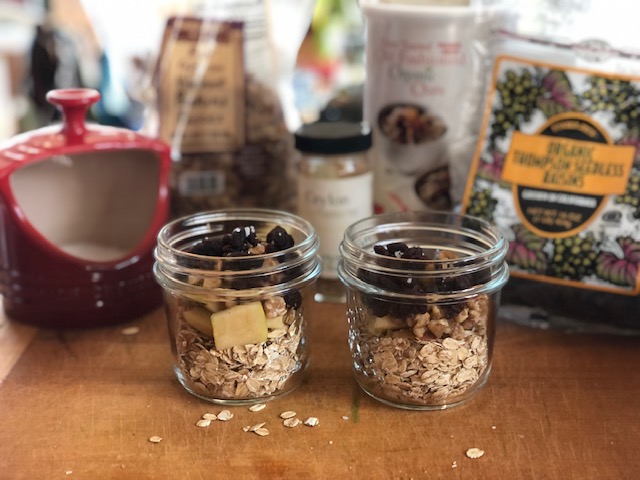
The recipe is ridiculously easy – 1/2 cup old fashioned oats (NOT instant) and 1/2 cup milk of your choice – I use almond milk. Throw in a pinch of salt, whatever fruits and nuts you like, stir it up and put in individual containers in the fridge. I suppose you could just put one large container in the fridge, but they are so cute when they are in serving sized containers. They can stay in there for a week or so. The end result is a chewy, fruity, nutty oatmeal. I prefer it cold or at room temp, straight out of the jar.

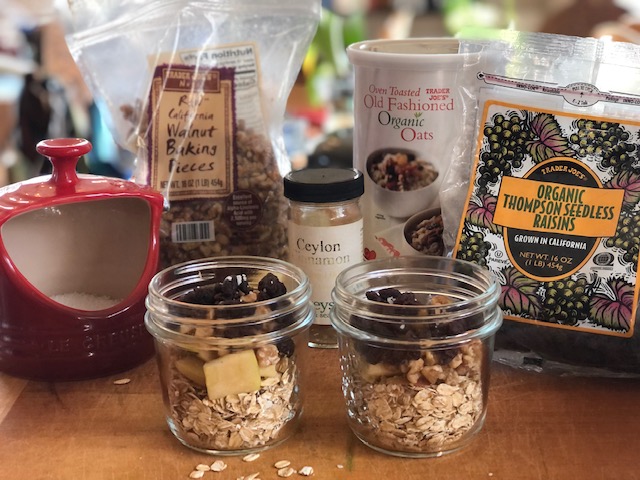
I like apples, walnuts, and raisins, and a dash of cinnamon.

I don’t add sugar to the oats; the apples and raisins add plenty enough for me. By the way, taste your fruit before you add it to the oats. If the flavor is disappointing before you put your fruit in the oats, the flavor will continue to be disappointing. That happened to me one time with some bland, blah apples that I used. I didn’t taste them before adding to the oats, and the overall flavor that week was disappointing. Never again! Only use the good stuff.

Overnight Oats

  • 1/2 cup old fashioned rolled oats
  • 1 pinch kosher salt
  • 1 hearty dash cinnamon
  • 1/2 cup thinly sliced apples
  • 2 tablespoons chopped walnuts
  • 2 tablespoons raisins
  • 1/2 cup almond milk

Mix all ingredients together and place in jar with an airtight lid in the fridge. Let sit in fridge for at least twelve hours, and up to a week. The longer the oats rest in the fridge, the better they taste. If you want to make enough for several servings (above is for one hearty serving), you can just double or triple the ingredients. Of course, you can use any ingredients you like, you can change the proportions, and you can add sugar, brown sugar, honey, or maple syrup if you like your oats on the sweet side. I just wanted to share my favorite mix with you. Enjoy!

Posted in Breakfast, Dairy-free, vegan | 3 Comments

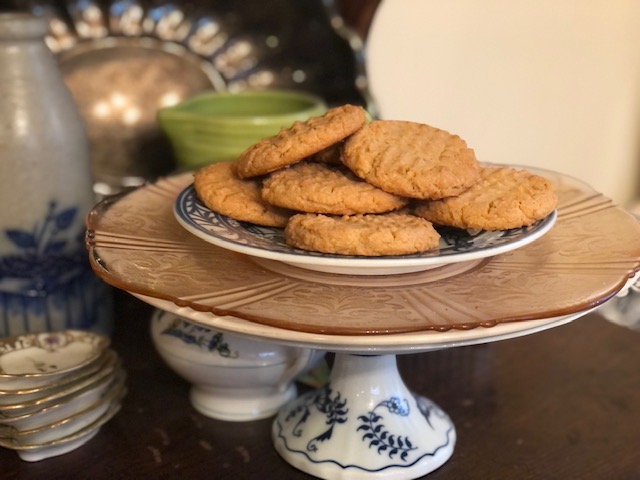
Favorite Peanut Butter Cookies

A couple of years ago, I went nuts (haha) trying to find the perfect peanut butter cookie. It’s strange, because I don’t consider myself a huge fan, but I just got a craving and had to do some recipe research.

I made a dizzying number of recipes that I found online, but didn’t find the one. Part of the problem was that I had some idea/memory in my head that I was trying to recreate, which proved to be impossible, so I gave up (!!!). Until just recently when a new craving hit. This time I thought about my mom’s Joy of Cooking cookbook, and thought that if ever she made peanut butter cookies, that is likely where she found the recipe.

A well loved 1943 Edition (photo credit mercari.com, used without permission)

The Joy of Cooking that I have is a much newer edition, and my mom’s book is safely tucked away in a box somewhere in my sister Linda’s house, so I decided to look online, and lo and behold, I did find the peanut butter recipe from the 1943 edition of the Joy of Cooking on Hilary Gauntt’s blog, Heron Earth, along with a sweet story behind the food memory. I was excited to try it! The first tray of cookies seemed a bit too crunchy and almost over-baked, and then the second tray seemed under-baked. Not feeling completely satisfied with the results, I decided to take a look at some other classic cookbooks (including my newer edition of Joy) and compare recipes.

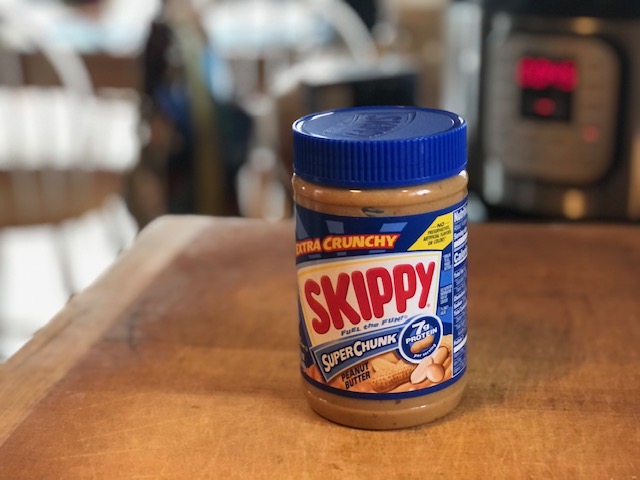
It turns out these other cookbooks, as well as the newer Joy, all have peanut butter cookie recipes, and their recipes have only half the amount of peanut butter… half! At some point, bakers must have decided to reduce the amount of peanut butter. Interesting. So you know I had to do a little experiment, and here is why: I think that the peanut butter cookies with only half the amount of peanut butter are not peanut buttery enough. I decided to make the 1943 recipe one more time, and instead of using a whopping one cup of peanut butter, I used 3/4 cup – a compromise. I also did this for a more practical reason: the peanut butter jar contains a little less than 2 cups of peanut butter, so if I want to get two batches of cookies out of it, I must use less than 1 cup per batch! Most peanut butter cookie aficionados will agree that Skippy (Jif is a close second) is the best peanut butter to use… it just behaves better, and it gives the cookies that flavor and texture that we have all come to know and love. At our house, for PB&J sandwiches or peanut butter toast, we like the natural kind of peanut butter, you know, just peanuts and salt, but for peanut butter cookies, it’s Skippy all the way, and the SUPER CHUNK please.

Reserved for peanut butter cookies!

I followed the recipe (aside from the slight reduction in peanut butter), including sifting the flour before measuring. I weighed the flour after sifting and measuring it, and ended up with 200 grams of all-purpose flour. I also skipped the vanilla by mistake, and decided the cookies didn’t need the vanilla. The only other change I made was adding more salt to the recipe. I more than doubled it! I kept tasting the dough and found it was too sweet, so I kept adding salt until it tasted yummy. I may have needed to do this because of using unsalted butter, but who knows? Jacques Pépin says to always taste your food as you prepare it, and who am I to argue with Jacques Pépin?

These cookies are crispy, melt-in-your-mouth deliciousness, and I don’t even love peanut butter cookies. But I love these. And my kids feel the same way. My work is done.

Update 10/09/2024: Apparently, my work wasn’t completely done. I have a new peanut butter cookie recipe that is a little sturdier than this one, and more closely resembles the peanut butter cookies of my childhood. You can find it here.

Favorite Peanut Butter Cookies

(Adapted from the 1943 edition of the Joy of Cooking)

  • 1/2 cup (1 stick) unsalted butter at room temperature
  • 1/2 cup light brown sugar, packed
  • 1/2 cup granulated sugar
  • 1 large egg at room temperature
  • 3/4 cup chunky peanut butter (Skippy or Jif)
  • 1 1/4 teaspoon coarse kosher salt*
  • 1/2 teaspoon baking soda
  • 1 1/2 cups (200 grams) all-purpose flour**
  1. Preheat oven to 375°
  2. Line a cookie sheet with parchment paper.
  3. In a large bowl, beat butter with a hand mixer until creamy.
  4. Add the sugars to butter and beat until light and fluffy.
  5. Add the egg, and then the peanut butter, beating until well combined.
  6. Sprinkle the salt and baking soda evenly over the wet ingredients and mix well.
  7. Add the flour and mix until just combined (did you notice this is a “one bowl” recipe?)
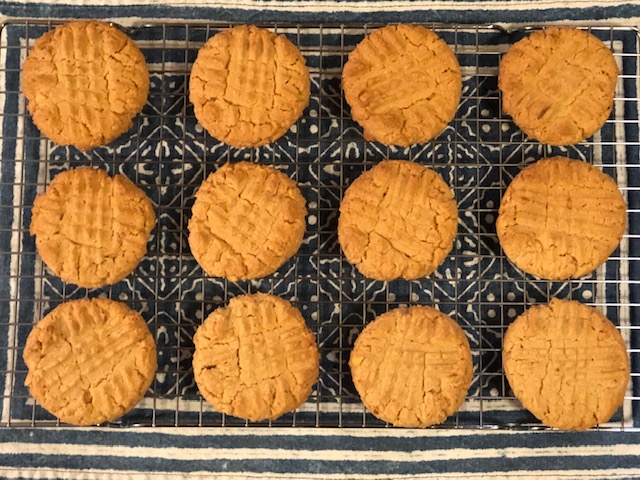
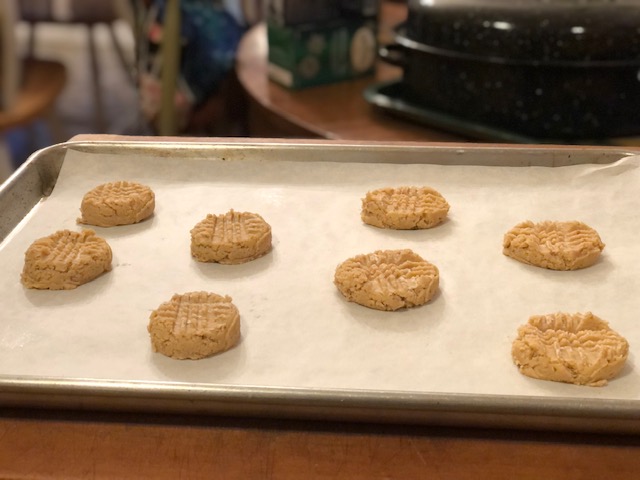
  8. Scoop cookie dough into 1 1/2 inch balls (I use a cookie scoop for this) and place them on the prepared cookie sheet, 2 inches apart. Dip the tines of a dinner fork in flour so they don’t stick, and then press into each ball of dough in a criss-cross pattern to flatten the ball. Bake on middle rack in preheated 375° oven for 12 to 15 minutes, or until the cookies have browned along the edges and slightly on the top***.
  9. Let cool on cookie sheet for 5 minutes before transferring cookies to a cooling rack to cool completely. Makes 2 dozen cookies.

Notes:

*If you use salted butter, reduce the amount of salt in the recipe to just 1 teaspoon. If you are worried about the overall amount of salt in the recipe, taste your cookie dough as you go. Skippy peanut butter is so sweet that the salt balances it out, in my opinion.

**The original Joy of Cooking recipe calls for “bread flour”. I like to use King Arthur all-purpose flour because it is high in protein content, similar to bread flour, so it’s a good choice. Also, the original recipe calls for sifting the flour before measuring out. I suggest that you do this as well, unless you have a kitchen scale, and in that case, just weigh out the 200 grams, no sifting necessary.

***For crisper cookies, flatten the cookies a little more, or you can also bake the cookies until they have browned completely on top, but not burned! I did a little experiment and made one tray of cookies with half of them pressed down more, and half of them pressed down less. The ones that were pressed down more browned more that the chubbier ones. Either way, they are fabulous! I guess I do love peanut butter cookies.

The four cookies on the right were pressed down flatter.

They were baked the same amount of time on the same tray. The ones on the right were crispier/darker, but honestly, they were both crispy and delicious! You can’t go wrong!

As a final note, I did try making this recipe using natural peanut butter, you know, just peanuts and salt. The results were less than satisfying – the cookies were dense, and the flavor was missing a certain je ne sais quoi. That being said, a friend of mine tried both kinds (yes, if you are a friend of mine, sooner or later you will be subjected to taste-testing), and she preferred the ones made with natural peanut butter! But everyone else preferred the Skippy version. I’ll let you decide.

On the left, the natural peanut butter version. On the right, the Skippy version.

Posted in Cookies, Desserts, Fun in the kitchen! | 3 Comments

Banana Bread

I have been using this recipe for years, and although I do some experimenting with other banana bread recipes on occasion, I keep coming back to this one.

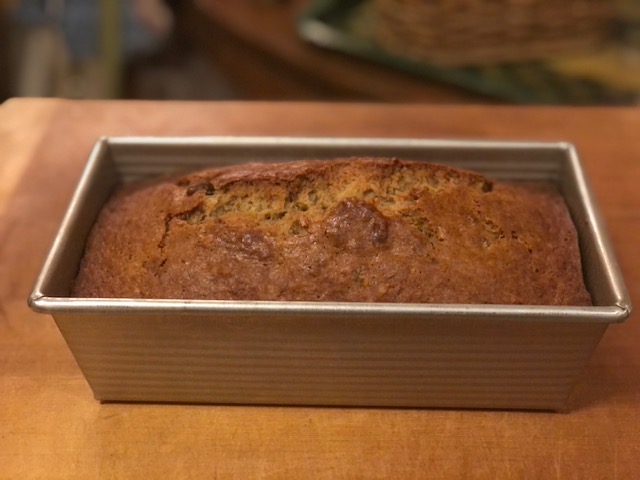
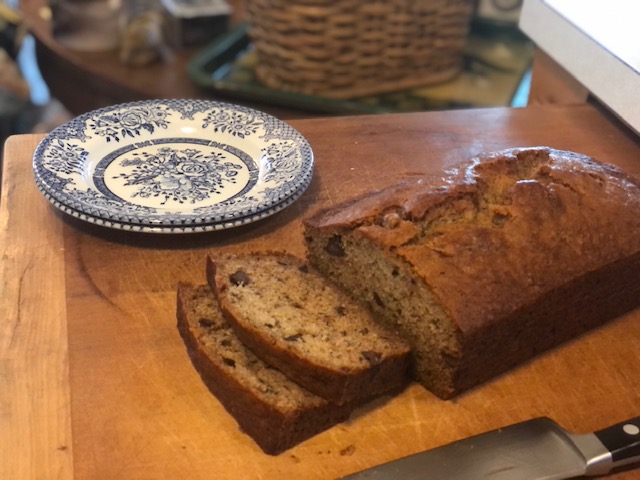
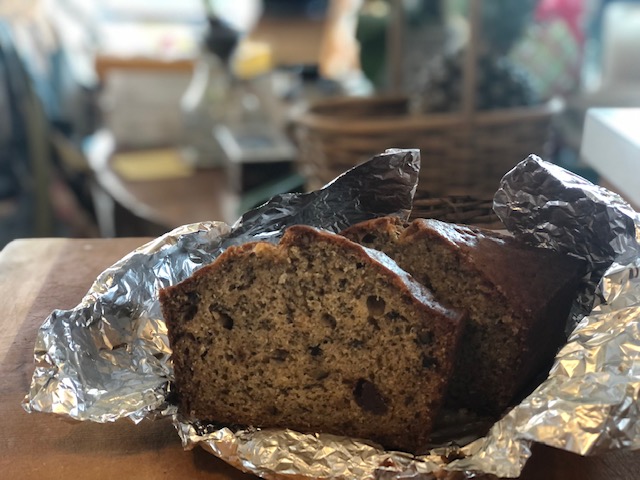
I love the cracked top.

I got the recipe from my friend Marivic. I remember the day vividly. Our kids were little, and Marivic invited us to go the pool with her and her boys. Marivic’s kids were a bit older, so she had a few more parenting years under her belt than I, and I was in awe of her ability to take her kids to a public pool and manage all the details. At the end of our swim session (after the traumatic-for-me part, which was dealing with showers in the locker room), we sat in her car and she opened up a foil wrapped package of sliced banana bread. It was hot in her car, so the bread was warm, and it had chocolate chips in it, which were all melty. It was the best banana bread I had ever had!

When they were little: Marivic’s son Toby on the left, Mara in the middle, and another friend Mia on the right.
She said she had made the bread that morning. I was again in awe of her parenting prowess. How did she manage to pack up all of the swim gear and make banana bread while wrangling two boys? She told me the recipe came from a cookbook for kids, so it was super simple to make – just one bowl and a wooden spoon. You gotta love that!

One bowl and a spoon!

This banana bread is simple and homey, slightly sweet with a velvety crumb. Normally I don’t like chocolate chips in quick breads, but it really works here, especially if you don’t use too many.

The perfect breakfast or anytime snack.

Banana Bread

  • 3/4 cup sugar
  • 1 1/2 cups mashed very ripe bananas (3 large)
  • 3/4 cup vegetable oil (I use olive oil)
  • 2 large eggs
  • 2 teaspoons vanilla extract
  • 2 cups (260 grams) all purpose flour
  • 1/2 cup finely chopped walnuts (optional)
  • 1 teaspoon baking soda
  • 1/2 teaspoon baking powder
  • 1/2 teaspoon kosher salt
  • 1/2 cup (scant) semi-sweet chocolate chips (optional)
  1. Heat oven to 325°
  2. Grease a 9″ x  5″ x 3″ loaf pan.
  3. In a large bowl, mash the bananas using the back of a wooden spoon. I use the most disgustingly ripe bananas I can find.  Stir in the sugar, oil, eggs, and vanilla and mix well.
  4. Dump the flour on top of the wet ingredients (you can use up to half whole wheat if you like), then sprinkle the walnuts, baking soda, baking powder, and salt over the top. Stir everything together with wooden spoon just until combined. Stir in the chocolate chips if using.
  5. Pour batter into prepared loaf pan and bake on center rack of preheated 325° oven for 60 to 70 minutes, or until a toothpick inserted into the center comes out clean. Let cool in pan for about 15 minutes, then take loaf out of pan and let cool completely on cooling rack. To store, wrap in foil and keep at room temperature. I recommend waiting until the next day to slice into the bread, if you can wait that long. Both texture and flavor are better on day #2!

And just for the fun of it, here are me and Marivic with friends Christy and Carolyn, from one of our bi-annual women’s retreats (2017).

I am on the left, Marivic is bottom center, Christy on the right, and Carolyn (Christy’s mom) top center. It was cold and windy!


Posted in Comfort Food, Dairy-free, Fun in the kitchen! | 4 Comments

Soft Sourdough Loaf

This is a variation of my white whole wheat sourdough sandwich bread. I love that bread so much, but it is baked in a loaf tin, and if I want to serve sourdough at a dinner party, I don’t want it looking like a sandwich loaf! I didn’t know if it was possible to reproduce this bread and have it turn out looking like an artisanal loaf, but I thought it was worth a try, and this is how my new favorite sourdough loaf was born.

Nice oven spring.

And here is why I call it soft. One of the things that drives me crazy about sourdough bread is that when it is baked at high heat, which is what everyone wants so they get that really good oven spring and a dark crispy crust, the crust is often just too hard. Or I should say it is too hard for me. So I decided I wanted to make a beautiful artisanal loaf, baked in a dutch oven, that would still have a somewhat soft-ish crust (read: it won’t break any of your teeth). Don’t get me wrong; I still like a good chewy, crispy crust. I just don’t want it to cost me a trip to the dentist.

This one has fresh rosemary in it.

So this one really fits the bill. How? Well, I bake it in a dutch oven, but at a much lower temperature. I didn’t think it would work, but it does! This loaf still works for sandwiches and toast, as it doesn’t have big holes in it. The day after it is baked, it slices up beautifully, the crust is thin and chewy, and the flavor is subtly tangy, as a good sourdough should be.

A few hole here and there, but not too many.

Makes a great sandwich! This loaf was cut on the same day it was baked.

And here is the beauty and versatility of this loaf: it can serve as a soft sandwich loaf, but it can also go on the table to be served with a saucy pasta, or any other dish that calls for a good crusty loaf. All that is required is to reheat the loaf in the oven at 350° or so, and the crust becomes perfectly crispy and delicious. For extra crispy crust, splash your loaf with water before reheating.

I know he looks like a loaf. I couldn’t resist.

Soft Sourdough Loaf

  • 330 grams room temperature water (filtered if possible)
  • 80 grams bubbly, active sourdough starter
  • 1 tablespoon sugar or honey
  • 2 tablespoons olive oil
  • 450 grams bread flour*
  • 50 grams all-purpose flour*
  • 2 teaspoons (12 grams) kosher salt

Day #1:

  1. Before making this bread, you will want to feed your sourdough starter a couple of times to make sure it is good and active… maybe once every twelve hours, including the night before you want to make your bread. In the morning, in a medium bowl, mix 80 grams of your active starter with 330 grams water, 1 tablespoon sugar, and 2 tablespoons olive oil. Whisk together until it looks milky and the starter is well incorporated.
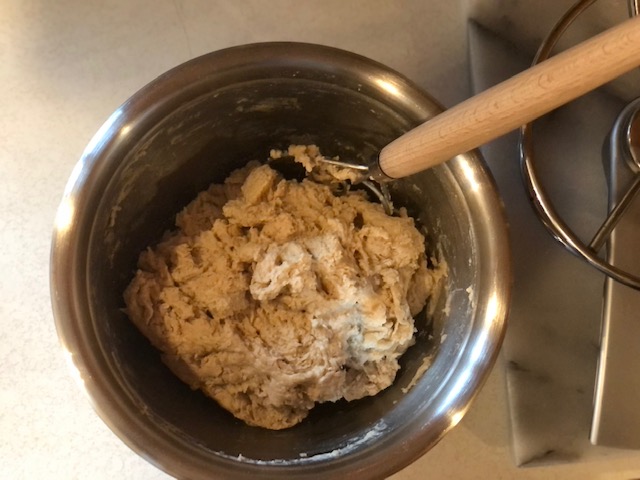
  2. Add the flour and salt, and mix with a wooden spoon or dough whisk until there are no dry floury bits. The dough will look shaggy.
  3. Cover the dough and let rest for about an hour (this is called the autolyse).
  4. After the dough has rested, mix the dough until it is smooth and springy: using a slightly wet hand (I keep a bowl of water handy), grab the dough from the side of the bowl and press it into the center. Rotate the bowl and continue to grab and press until you’ve gone around a couple of times. This should take maybe about a minute. The dough will become more elastic and springy rather quickly. Flip the dough over in the bowl (smooth side up), cover the bowl with plastic wrap or similar covering, and leave on your counter.
  5. After about an hour, using a bowl scraper or spatula, scrape all along the side and bottom of the bowl to make sure the dough isn’t sticking. With wet hands, scoop up the dough from the middle, letting the dough hang and stretch. Gently release the dough into a pile and rotate the bowl one quarter turn. Repeat, scooping up the dough and letting it hang and stretch. I sometimes jiggle it to encourage it to stretch a bit more. then cover the bowl and leave on the counter. These are called coil folds**, and they will help develop the gluten in the dough, giving the finished bread a nice structure. Leave the dough in the covered bowl on your kitchen counter. You can come back and do another set of folds in about an hour if you like. Then leave the dough covered for anywhere from six to eight hours, or until it has almost doubled in size, and has a bubble or two on the top.
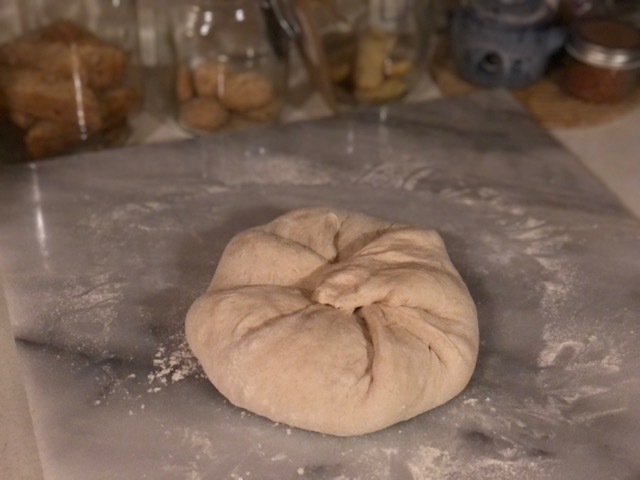
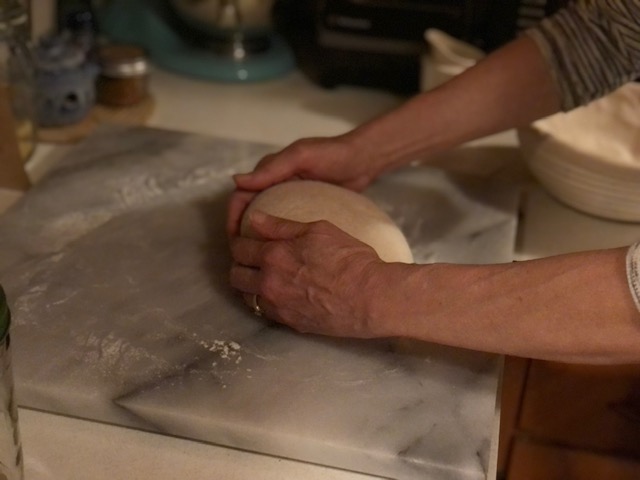
  6. Once the dough has almost doubled in size, gently scrape the dough out onto a lightly floured work surface using a spatula or bowl scraper. It is time to shape your dough. Take your fingers and slide them under the sides of the dough and gently stretch the dough out a bit to make a large circle. Lightly flour your finger tips and, acting like you are playing the piano, gently dimple the dough. This helps to minimize large holes in your bread. Fold the sides of the dough into the center, starting at one side and continuing until you have gone all the way around, brushing off any excess flour as you go. Flip the whole thing over with the assistance of a bench scraper or bowl scraper. The dough will be “smooth side up”. Now cup the dough with your hands and draw it towards you, pressing slightly under as you go. Rotate the dough a quarter turn and repeat. Do this several times, but gently! You don’t want the dough to tear. You want the dough to be evenly round, and to feel taut and a bit springy. Once it is shaped nicely, let it rest for ten minutes.
  7. While the dough is resting, grab a colander (or bowl) and clean, dry tea towel. Flour the tea towel. Line your colander with the floured tea towel, floured side facing up. After your dough has rested for 10 minutes, lightly flour the top of the dough and smooth out the flour to have a nice even layer. Carefully pick up your dough with the assistance of a bench scraper or bowl scraper and gently flip it over, and place your dough smooth side down into your prepared tea towel/colander**. Lightly flour the seam side of the dough and cover lightly with the tea towel. Place in fridge to rest and rise overnight.

Day #2:

  1. You can get started any time you feel like it. When you are ready, place your dutch oven and lid into your oven on the middle rack, then preheat the oven to 375°F***. Let oven and dutch oven preheat for 20 minutes or a bit more.
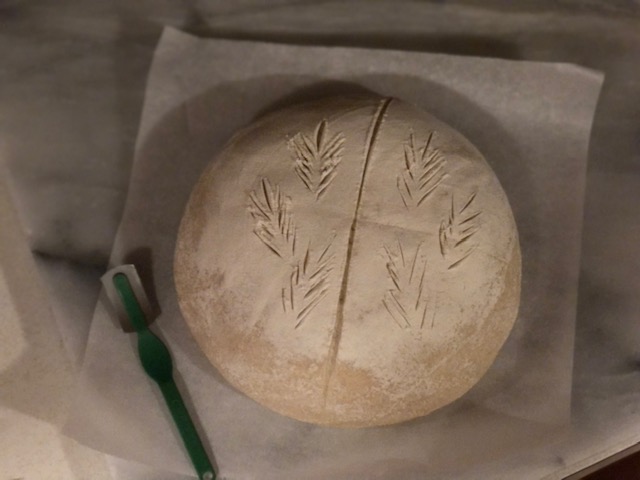
  2. Once the 20 minutes are up, take your bread dough out of the fridge. Open up the tea towel. Take a square of parchment paper and lay it on top of the dough. Place a plate on top of the parchment, and flip the whole thing over. Remove the colander and the tea towel. Using a sharp knife or razor blade, make a big slash about 1/4 inch deep across the loaf. If you wish, you can cut more designs making the cuts very shallow.
  3. Using oven gloves or mitts, take your dutch oven and lid out of your oven. Be careful, as it will be very hot. Take a hold of the dough by the corners of the parchment paper, and drop the loaf into the dutch oven. Shake it from side to side to make sure the loaf is centered. Put the lid on and place in your 375°F oven and bake for 45 minutes. The lid stays on the entire time.
  4. When the 45 minutes are up, remove the dutch oven and carefully lift out your beautiful bread. If you have a quick-read thermometer or thermapen, check the internal temperature of your loaf – it should be somewhere between 205°F and 210°F. If you don’t have a thermometer, you can usually tell your loaf is done by the light golden brown color, and if you tap on the bottom of the loaf, it will have a hollow sound. Let the loaf cool on a cooling rack for at least two hours before cutting into it. Enjoy!

Notes:

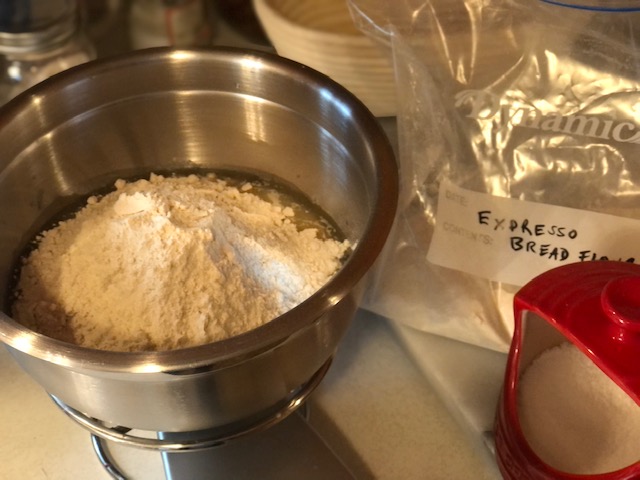
* Lately I have been making this bread using Cairnspring Mills Expresso Bread Flour. I have been using their Sequoia All Purpose Flour to soften the bread a bit. Both of these flours have more bran and germ than most other flours, so the result is an earthy loaf. If you are lucky enough to be in the area and get your hands on some of this flour, I highly recommend it. If not, another blend of flours I like for this loaf is King Arthur Bread Flour (200 grams), plus King Arthur All Purpose Flour (100 grams), plus King Arthur White Whole Wheat (200 grams).

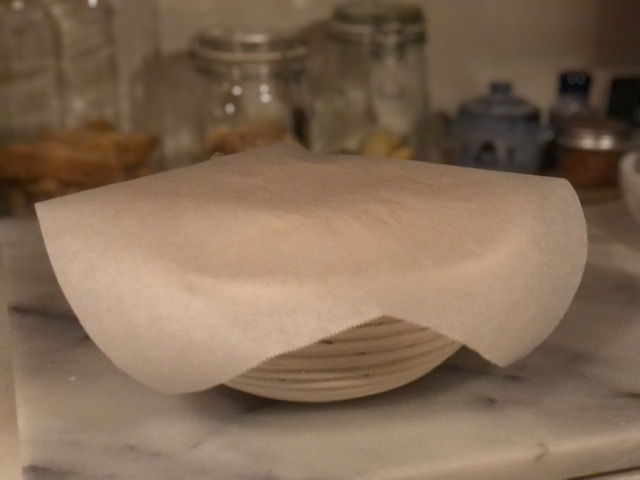
** I now use a proofing basket (also called a banneton) with a linen liner instead of a colander and tea towel. Either set up works well. The banneton takes up less room in the fridge (and that is important because our fridge is small!), and I can easily clean the liner by rinsing it in hot water and hanging it to dry on a hook in my kitchen. When using the banneton and liner, I just use one of those reusable shower cap-style covers on it when I put it in the fridge for the overnight rise. Super easy.

*** Update! Recently I have started to preheat my oven and dutch oven to 450°F so I get better oven spring (that initial rise from the blast of heat), but I immediately turn the oven down to 375° once the bread is in the oven, and I still bake the bread covered the entire time. You may want to try this if you find you are not getting the oven spring that you would like, but don’t forget to turn the oven temp down to 375°, that’s the risky part.

Here are some pictures of the process:

Use an active starter that has at least doubled.

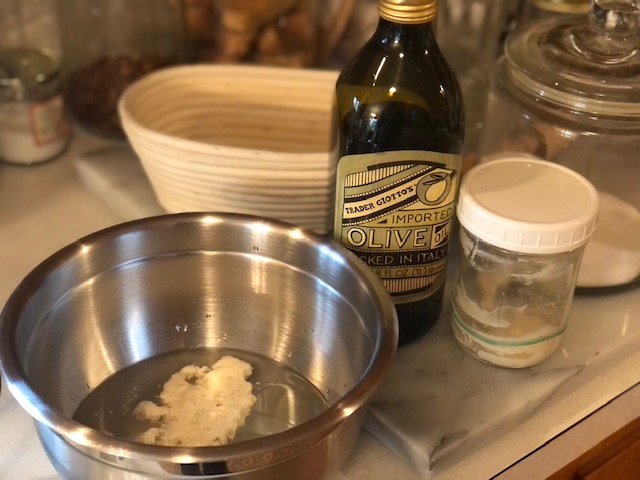
Put water, starter, olive oil and sugar in medium bowl.

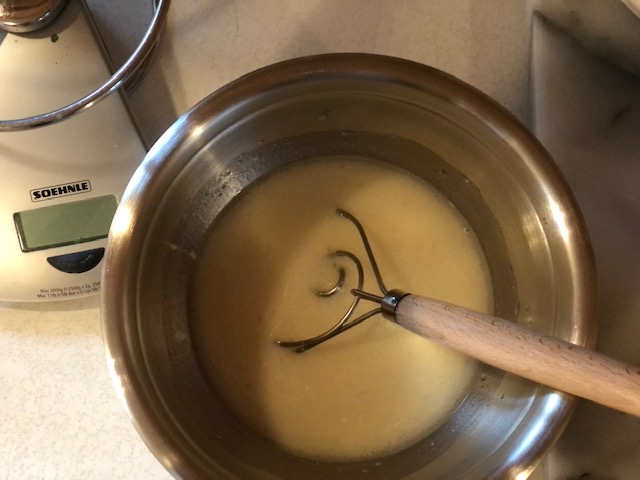
Stir water, starter, sugar and oil until milky.

Add the flours and salt.

Mix until there are no more floury bits.

Cover and let rest for about an hour.

Mix again with a wet hand, bring the dough from the sides into the center, going all the way around until dough is smooth and springy.

Then flip the dough over. Nice and smooth.

Cover again and let rest for another hour.

Time for a fold. Stick your hands underneath and lift the dough up.

Lift it nice and high so the dough can stretch. Then drop it back down onto itself.

Rotate the bowl a quarter turn and do it again.

Cover bowl and let rest for 6 to 8 hours, or until dough has almost doubled.

Almost doubled and ready to go!

Scrape the dough out onto a floured surface.

Stretch the dough gently into a wide circle, and dimple the dough.

Fold the edges of the dough into the middle, going all the way around.

Flip it over so it is “smooth side up”.

Draw the dough toward you, rotating the dough and repeating until there is nice tension.

Nice and springy with good tension.

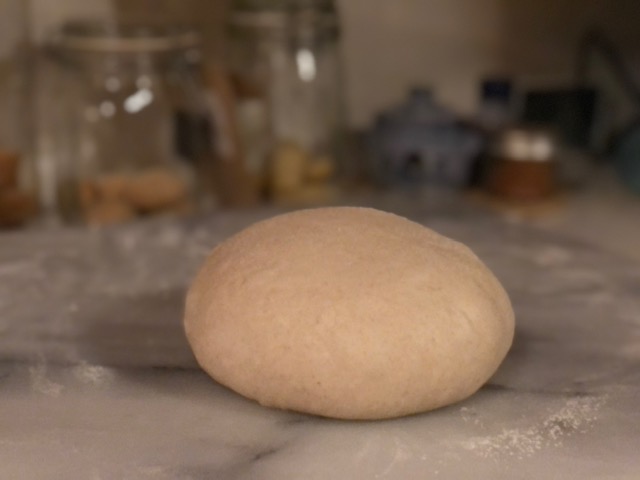
Flour the top of the dough.

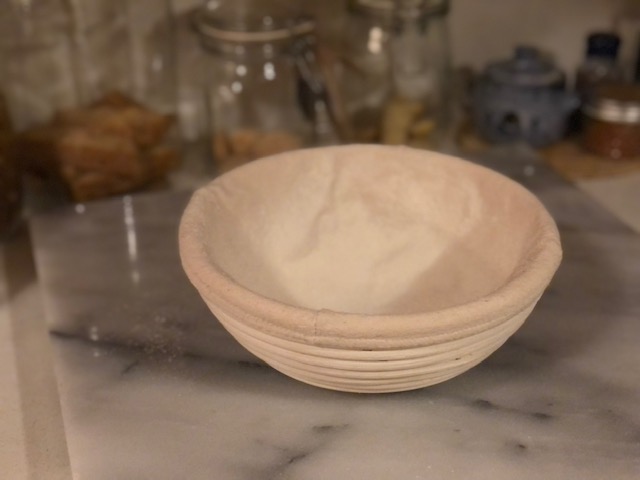
Flour your banneton liner or your tea towel/colander set up.

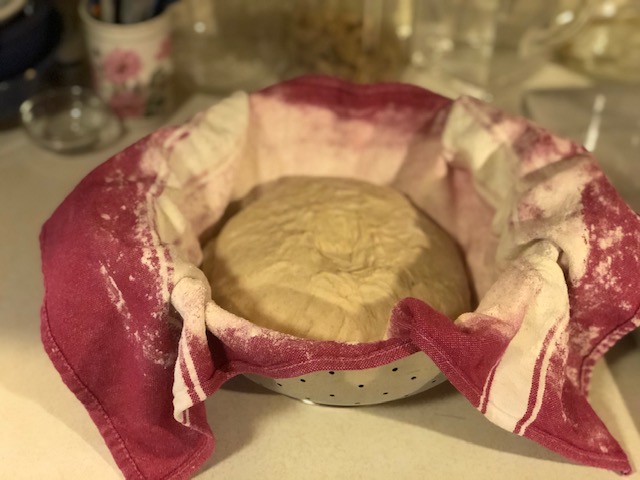
Tea towel/colander set up looks like this.

With the assistance of your bowl scraper, flip your dough into the lined banneton or colander so the smooth side is down and the seam-side is up.

Tea towel/colander set up looks like this.

Cover with plastic wrap or a reusable cover, and place in the fridge to rise overnight.

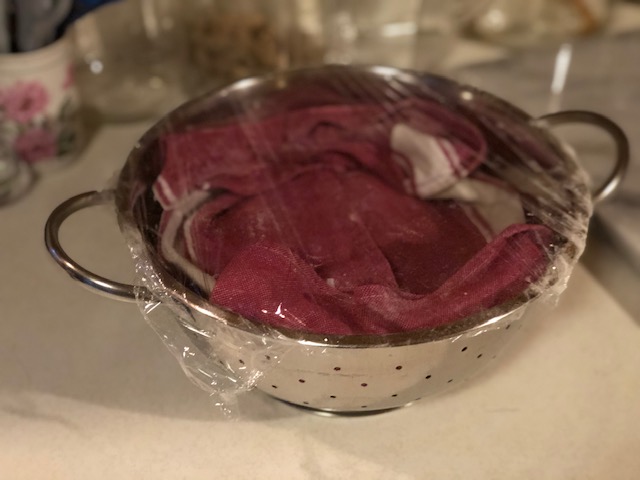
If using tea towel, fold over the edges of towel and lightly cover with plastic wrap. Place in fridge overnight.

Day #2: Place dutch oven in your oven and preheat to 375° for at least 20 minutes.

Once oven is preheated, remove dough from fridge and remove cover. It should be nice and puffy!

Cover with a square of parchment paper.

Flip the whole thing over.

Remove basket/colander and liner.

Make a 1/4″ cut across the loaf with a sharp knife or razor. You can also make more shallow decorative cuts.

Carefully remove dutch oven from oven and plop your bread and parchment paper inside of it.

Cover and put back in oven. Bake for 45 minutes covered the entire time.

After 45 minutes, remove dutch oven and carefully remove the lid (there will be steam).

Place your work of art on a cooling rack and let cool for at least 2 hours before cutting into it.

This one I reheated in a 350° oven to give it the dark, crispy crust.

Posted in Fun in the kitchen!, Sourdough | 21 Comments

Anise Pizzelle

Last year for Valentine’s Day our baking group did a cookie exchange, and Sarah brought pizzelle. I don’t think I had ever had one before, but they struck a nostalgic chord with me, being that they are Italian cookies flavored with anise.

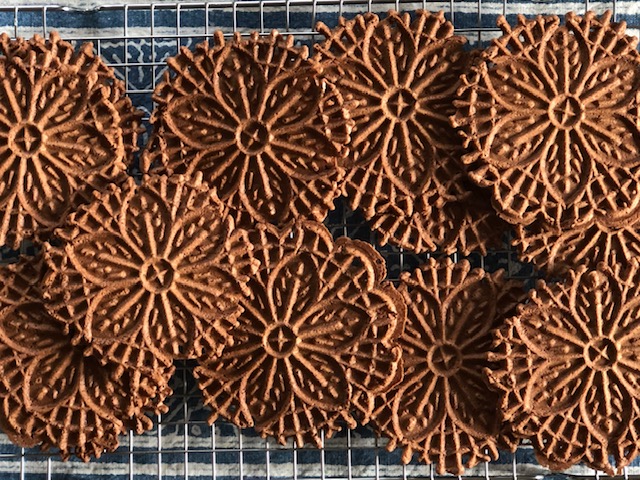
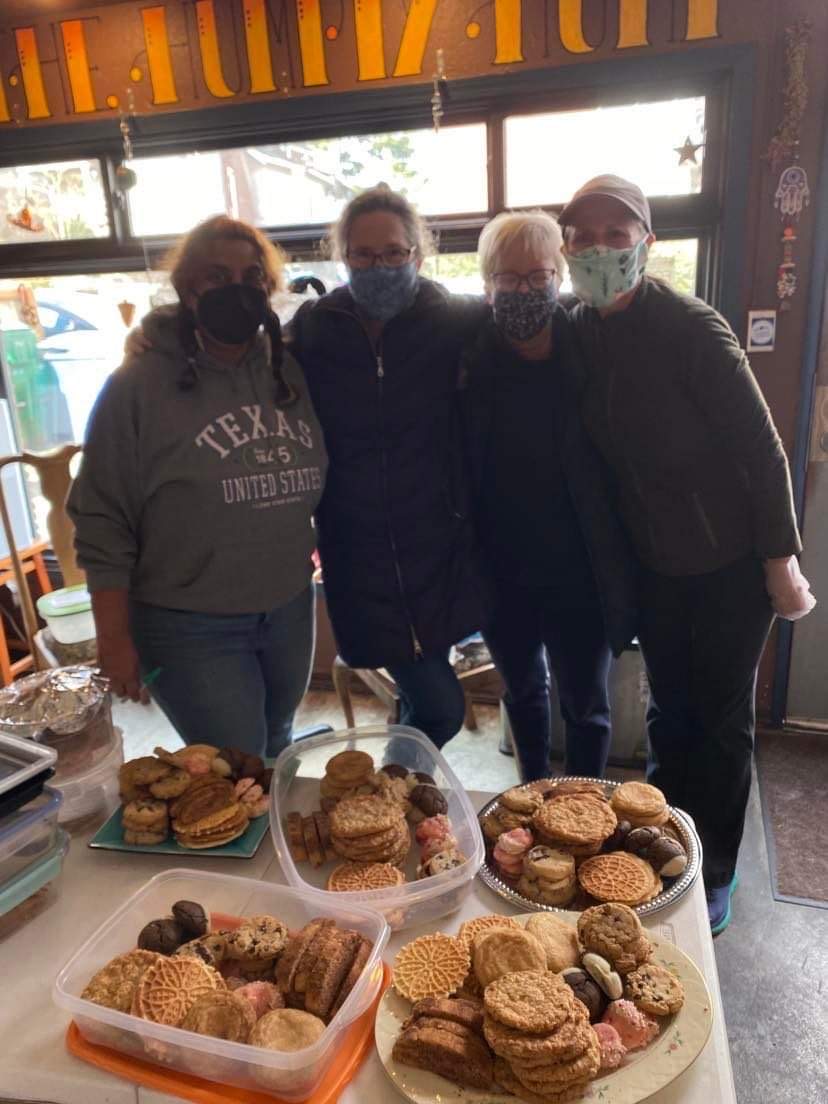
Cookies from our cookie exchange; Sarah’s pizzelle at 3 o’clock.

Pretty much anything flavored with anise is going to be a huge hit with me, like these almond-anise biscotti. Growing up in St. Louis, we would often go to the Italian neighborhood known as “The Hill” to do a little grocery shopping at Viviano’s. The second you walked in, you would be hit with all of the wonderful aromas – freshly baked bread, strong cheese, olives, olive oil, coffee, and yes, you’ve got it, anise.

Anise seed: I buy it in bulk.

My mom loved all things Italian, but perhaps especially the cookies. When we couldn’t make it to The Hill, she would sometimes bring home Stella D’Oro cookies from the corner grocer. I especially remember these cookies during the holidays – all different shapes, different colors, and all of them crispy and delicious. So how could I not just adore pizzelle? Thin, light, airy and crispy wafers, delicately flavored with anise of course; a perfect accompaniment to a good cup of tea or coffee.

I sprinkled these with a bit of powdered sugar; not necessary, but adds a festive touch.

So this year, Nicole from our baking group asked about pizzelle, and asked if anyone had a good recipe. I remembered Sarah’s phenomenal pizzelle from last year, and turns out she used Martha Stewart’s recipe. Since I never followed up on my obsession last year, I decided it was time. Luckily for me,  my neighbor up the street has a pizzelle iron*, which she kindly loaned to me. I pulled up the Martha Stewart recipe and got busy.

They make festive holiday gifts!

I am always at a loss when recipes have flour measurements in volume, but not weight. Sometimes the author of the recipe is heavy handed with their flour. Other times, they are not. So I usually try the recipe first going with something middle of the road, like 130 grams of flour per cup. Then I tweak it back and forth until I find the perfect amount for me. In this case, I ended up making 5 batches before being satisfied (one of the batches was a different recipe that seems to be the standard that you will find everywhere, and I did NOT like it). In the end, Martha Stewart’s recipe is just lovely. I need look no further. So here I am, sharing it with you, along with a few tips to make the process a bit easier. Buon Natale!

Anise Pizzelle

(Martha Stewart’s recipe)

Makes approximately 2 1/2 dozen pizzelle

  • 5 tablespoons unsalted butter, melted and cooled to room temp
  • 1 1/2 teaspoon anise seeds, lightly toasted and ground
  • 1 1/4 cups (150 grams**) unbleached all-purpose flour
  • 1/2 teaspoon baking powder
  • 1/2 teaspoon kosher salt
  • 2 large eggs
  • 3/4 cup granulated sugar
  • 1 teaspoon vanilla extract
  • 1 teaspoon anise extract
  1. Melt the butter and set aside to cool.
  2. Toast the anise seeds in a skillet over med-high heat for about a minute, until they are fragrant. Pour into a bowl to cool.
  3. In a small bowl, whisk together the flour, baking powder, and salt.
  4. Using a mortar and pestle (that’s what I use) or a spice grinder, grind the anise seeds until mostly fine. Add to flour mixture and whisk in.
  5. In a large bowl, whisk together the eggs and sugar until light in color. If using a whisk, this will require a little elbow grease. I use an electric hand mixer to make it easier. Takes a minute or so with the hand mixer. Takes a little longer with the whisk.
  6. Add the vanilla and anise extracts to the egg mixture; whisk until well incorporated.
  7. Continue to whisk the egg mixture as you slowly pour in the melted butter. Mix well.
  8. With a wooden spoon or danish whisk, stir the flour into the egg mixture little by little, maybe a cup at a time. Keep adding flour until all of it is incorporated. Do not over mix.
  9. Your batter should be the consistency of a thick cake batter, and it should look glossy. Leave batter to rest on your kitchen counter, lightly covered, for about an hour or two. This step is optional, but I find the batter is easier to work with once it has rested and the flour has become more hydrated.
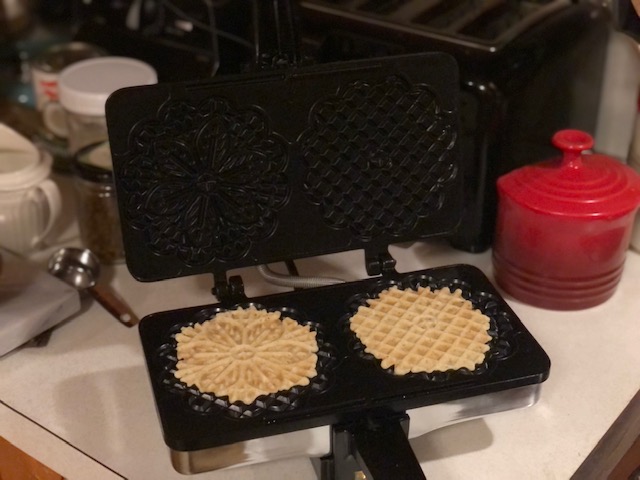
  10.  When ready to get started, preheat your pizzelle iron for at least 15 minutes to make sure it is evenly heated. Once preheated, brush lightly with oil. You will only do this once. Place a 1 tablespoon dollop of batter in the center of each pizzelle pattern on the iron (I use a one-tablespoon cookie scoop and it works really well). You can place the dollop slightly back of center to try to get the cookies to be well centered once flattened. After a couple of tries, you will find what works best. Close the iron and bake for 40 to 60 seconds, or until the pizzelle are a light golden color. You’ll need to practice a little to get them just the way you like them. Remove using a thin plastic or bamboo knife to get under the edge, and let cool completely on a cooling rack (no overlapping). For consistent results, close the iron and let it come back to temp every time; this only takes a minute or less, so it’s worth it. Store pizzelle in an airtight container. These keep well for up to a month, if they last that long. The flavor and texture improve as they age. Serve with your favorite hot beverage or ice cream.
  11. If you would like to make cannoli shells**** or ice cream bowls, shape the pizzelle immediately after removing from the iron. They will harden up quickly – in about a minute. For cannoli, wrap the pizzelle around a wooden dowel or handle of a wooden spoon and hold it there for about 30 seconds before releasing to cool. For ice cream bowls, turn a drinking glass upside down, and place pizzelle around the bottom-now-top to shape it. Remove after one minute and allow to cool on cooling rack

Notes:

*The pizzelle iron my neighbor loaned me is a CucinaPro non-stick pizzelle maker, and it works well. But for my own, after doing a lot of research, I have ordered a pizzelle iron from C. Palmer Mfg. Co. Inc., a family owned and run company founded by an Italian immigrant (Carmen Palmieri) in the 1940’s. I get excited about things like this. I will give an update as to how the machine works… stay tuned.

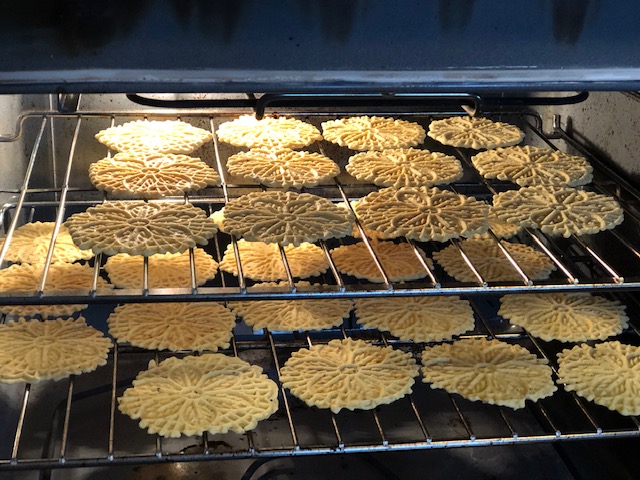
**If you are not using a kitchen scale, stir your flour to aerate and fluff it up before lightly sprinkling your flour by the spoonful into measuring cup, and use the straight edge of a knife to level the flour. By this method, your flour should weigh approximately 120 grams per cup, and 1 1/4 cup would weigh 150 grams. If you use more flour for this recipe, up to 180 grams, the pizzelle will be a little more cake-y/less crispy… lighter in texture. Still good, but I prefer them on the crispy side. Any time your pizzelle come out not crispy enough, you can always put them directly on an oven rack in a 150° oven and let them crisp up. Maybe leave them at this temperature for 15 minutes or so, and then turn the oven off and let the cookies stay in there until they come to room temp. That should do the trick.

***For chocolate pizzelle, add 3 tablespoons cocoa (high fat if possible) and an additional 3 tablespoons of granulated sugar to the recipe. They are ridiculously delicious.

****To make a traditional cannoli filling for 8 cannoli, press 1 cup whole milk ricotta between layers of paper towels to remove excess moisture. Mix strained ricotta with 1/4 cup plus 2 tablespoon (~45 grams) powdered sugar3 tablespoons (~30 grams) finely chopped bitter-sweet chocolate, or you can use mini chocolate chips, and a good dash of cinnamon. Pipe into cannoli shells using a piping bag with a large round tip, or a ziploc bag with the corner cut out of it. Do this just before serving so the shells don’t get soggy. If you like, you can garnish the ends of the cannoli with finely chopped toasted pistachios, and sprinkle powdered sugar over the tops. Finally, if the ricotta texture is not to your liking, you can fold in some whipped cream to smooth it out a bit. But I would highly recommend trying the straight ricotta filling first, for an authentic experience.  This recipe is from Cooking Classy.

And now, a few pics of the process:

Batter is thick and glossy.

This cookie scoop makes things a lot easier.

Dough is slightly back of center.

Light golden brown is perfect for me.

Some are cooling, and one is being shaped for cannoli.

This batch wasn’t crisp enough, so they are crisping in a 150° oven.

Cannoli!

Chocolate Pizzelle

And just for the fun of it, I’m including a few pictures from our cookie exchange last year, which was hosted by Prashanthi, owner of Makeda & Mingus – an adorable café in the Greenwood neighborhood in north Seattle. While we were there, Prashanthi made me the absolute best rose cardamom latté – out of this world, and the perfect accompaniment to Sarah’s pizzelle!

I can’t wait to do another cookie exchange with these bakers!

A few of us, from left to right: Prashanthi, me, Deb, and Jill

Posted in Cookies, Desserts, Fun in the kitchen! | 2 Comments

Sourdough Waffles

It started snowing here this morning, which is rare for November in Seattle. The girls stared longingly outside, wishing for a snow day. I mean, why wouldn’t they, with a whopping 1/16th of an inch accumulated, and nothing sticking on either the sidewalks or streets?

You can see the huge snowfall, if you look past our yet unadorned Christmas tree.

Mara said to me, “Yes, mom, I know, I know. When you were a kid you walked to school backwards in the freezing snow, screaming all the way to school because it was so cold!”  Could it be that I have become that parent, the one who says, “When I was your age…”, but it’s true! I remember many a cold, snowy St. Louis winter’s day, walking backwards to school, because if you walked head-on into the biting wind, it would freeze little icicles in your nostrils and sting your nose and cheeks. After the girls left for school, I looked outside and felt the calm and quiet that always accompanies the first snow. I said to Matthew, “It really does kind of feel like a snow day, doesn’t it?”

So cozy in our kitchen this morning. I’m glad I don’t have to go to school.

Well, nothing takes the sting out of having to go to school when it’s snowing outside like a sourdough waffle breakfast. Actually, I make these all the time now, which is why I have to write about them. The girls like them in the morning before school. Mara just grabs one and eats it plain, as if it were a cookie or a donut. Millie prefers to have hers with homemade yogurt and maple syrup.

And here is Millie, perched precariously while preparing her morning waffle.

I have another favorite waffle recipe that I have been making for a couple of years, but could it be that this one is becoming the new favorite? Mara says she likes the flavor better (Hello, sourdough!), and Millie says they keep much better than the others (another nod to sourdough!)… we keep the extras in the fridge and pop them in the toaster for an easy before school breakfast. And even Matthew grabbed one today as he walked by the kitchen table; I love to see the look of surprise and delight on his face when something tastes better than he thinks it is going to.

Sourdough starter is the magic ingredient.

Sourdough Waffles

(Adapted from Emilie Raffa’s recipe, makes about a dozen 4″ waffles)

  • 1 1/2 cups (~190 grams) all-purpose flour*
  • 2 Tbsp granulated sugar
  • 1/2 tsp kosher salt
  • 2 tsp baking powder
  • 1 tsp baking soda
  • 1 cup (~240 grams) sourdough discard
  • 2 large eggs
  • 1 cup milk
  • 6 Tbsp melted unsalted butter
  1. Melt butter and set aside to cool.
  2. Turn your waffle iron on to preheat.
  3. In a large bowl, whisk together all of the dry ingredients.
  4. In a medium bowl, beat the eggs, then whisk in the sourdough discard until incorporated. Then whisk in the milk and butter.
  5. Add wet ingredients to dry ingredients and whisk until everything is well mixed. Do not over mix.
  6. Ladle 1/2 cup of batter into each 4″ square of your waffle iron. Bake until the steam subsides.
  7. Serve hot with all of your favorite toppings. Leftovers keep nicely in the fridge for at least a week… they’ve never lasted longer than that at our house.

Notes:

*If you are not using a kitchen scale, stir your flour to aerate and fluff it up before lightly sprinkling your flour by the spoonful into measuring cup, and use the straight edge of a knife to level the flour. By this method, your flour should weigh approximately 120 grams per cup. Also, you can replace 1/4 cup of all-purpose flour with any whole grain flour for added flavor.

**For spiced pumpkin waffles, add 1/2 cup pumpkin purée to the wet ingredients, and 1 teaspoon cinnamon, 1 teaspoon ginger, and 1/8 teaspoon allspice to the dry ingredients before blending. Really yummy!

Pumpkin waffle with yogurt and maple syrup.

And just for the fun of it…

From our recent annual trip to Trinity Tree Farm.


Posted in Comfort Food, Fun in the kitchen!, Sourdough | 1 Comment

Cornelia’s Pumpkin Pie

Growing up, pumpkin pie was a big deal around our house. It was kind of legendary… well, to us anyway. Every Thanksgiving my mom would make 5 or 6 pumpkin pies, along with all the other traditional fare, and we would have a huge gathering with all the cousins. The recipe my mom used came from my paternal great grandmother Cornelia, whom I never met. I have an old recipe card with her recipe, type-written by my mom.

What I love about this recipe card is seeing all the additions and modifications; clearly my mom suffered over getting things just right in the same way that I do. And the secret ingredient for this pie? Bourbon. You can see written in on the card at the bottom in my mom’s handwriting, “1 tsp grated orange rind instead of bourbon“, and then it is crossed out. I’m laughing to myself about this. Sorry, but orange zest just won’t do it. On the backside of this recipe card my mom typed out her own version.

So on this one, she basically doubled the recipe, increased the sugar, halved some of the stronger spices, tripled the pumpkin, decreased the bourbon… well, she changed a bunch of things. And here’s another funny bit. At the bottom of the recipe card, next to the bourbon, she wrote, “or 1 jigger sherry brandy“, and then that got erased. Not just crossed out, but erased! But you can still see it if you look closely. I’m guessing my mom really wanted to replace the bourbon with other things, but in the end, the bourbon won out. And what is a jigger, you may ask?

Here is a jigger! Maybe Cornelia had one of these?

A jigger is a measurement equaling approximately 2 tablespoons, so if you don’t have one of these cool jigger-measuring-thingies, you can just use a tablespoon. But when I found one of these at the thrift store, you know I had to get it.

To be honest, trying to make a really good pumpkin pie with a really good crust is what started my obsession with pie crust, oh so many years ago. Every time November rolled around, I found myself still not being able to make a decent crust. Now here is the kicker: sometimes I could make a decent crust, but then when I would use it for a pumpkin pie, suddenly that pretty decent crust became either tough and disappointing, or flabby on the bottom. And then the dreaded cracked pumpkin pie would happen too.

Smack dab in the middle.

So here I am finally writing about this pumpkin pie, because I think I’ve finally got it figured out! What’s the trick? Well, first of all, I don’t use the directions on the back of the Libby’s can of pumpkin; that renders a soggy bottom of a pie crust. Not that there is anything wrong with that. That is what I grew up with, and that’s how I always thought it was supposed to be! But for a well baked pie crust, I “blind-bake” the crust. Like, blind-bake the heck out of it. Way more than I ever thought was possible or necessary.

Ready to go into the oven to “blind-bake”.

Secondly, I don’t stick a knife into the pie to see if it’s done. Instead I check by nudging the pie plate while it’s still in the oven: if the pie filling ripples like miniature waves, it’s not done yet. Once the pie filling jiggles (like jello) in the center, but doesn’t ripple, it’s time to take it out of the oven. The custard will continue to set after removing it from the oven.

Right out of the oven. It will settle down in a few minutes.

In the end, I decided I like Cornelia’s original recipe. It is creamy, dark and spicy, not too sweet, and not too squash-y either, if you know what I mean. I did make a few changes, so it’s a mix of her recipe, my mom’s, and my own.

Cornelia’s Pumpkin Pie

  • 1 disc pie dough* (made from scratch – try this one or this one)
  • 3/4 cup granulated sugar
  • 2 tablespoons all-purpose flour
  • 1 teaspoon kosher salt
  • 1 teaspoon ginger
  • 1 teaspoon cinnamon
  • 1/2 teaspoon allspice
  • 1/4 teaspoon cloves
  • 2 large eggs at room temperature
  • 2 cups Libby’s pumpkin (or fresh roasted pumpkin, well drained)
  • 1 1/4 cups heavy cream at room temperature**
  • 1 jigger (scant 2 tablespoons) good quality bourbon
  • 1 egg yolk for egg wash
  1. Roll out your pie dough, put it in a pie pan, crimp as desired, and refrigerate it in its pan for at least 30 minutes. A couple of hours is better. (You can do this up to a day or two ahead of time if you like. Once the crust is well chilled, wrap it well, pie pan and all, and store it in your freezer until you are ready to bake it.)
  2. When ready to get started, preheat your oven to 400° and make sure to have one oven rack in the lower third of your oven and one oven rack in the center. Pop your already chilled pie crust into the freezer while the oven is preheating.
  3. In a small bowl, whisk together the sugar, flour, salt, ginger, cinnamon, allspice, and cloves. Set aside.
  4. In a large bowl, whisk the eggs until well beaten. Whisk in the sugar/flour/spice mixture. Next whisk in the pumpkin, heavy cream, and bourbon. Set aside on your counter (it is okay, and even preferable, for your filling to be at room temperature).
  5. Once your oven is preheated, line pie crust with parchment paper*** or aluminum foil, making an awning over the edges of the crust to protect from burning, then fill to the top of the crust with dried beans or pie weights.
  6. Place the prepared crust on a cookie sheet on the bottom rack of oven and bake for 40 minutes, rotating the crust halfway through the baking time.
  7. When 40 minutes is up, remove crust from oven and carefully remove the dried beans and parchment and save beans indefinitely for blind-baking your crusts. Beat the egg yolk with a pinch of salt and brush the inside of the hot crust with it. Put back in the oven and bake for one more minute. Remove crust from oven and turn the temperature up to 450°.
  8. If necessary, move whisk slowly through your pie filling, without creating bubbles, in case any of the spices have settled. Pour into hot crust. You will want to have a foil ring or crust shield around the edge of your crust to prevent it from burning.
  9. Place your pie, still on the cookie sheet, on the center rack of your oven, and bake for 15 minutes in your 450° oven. After 15 minutes, turn the temperature down to 350° and bake for 25 to 30 minutes more, or until the filling is set. I start checking at 25 minutes****. I nudge the pie pan, and if the center of the filling ripples like teeny waves, looking liquidy just under the surface, the pie is not done. Continue to check every 3 minutes or so. When the center of the pie jiggles or trembles (like jello), but no longer has the teeny liquidy ripples, your pie is done. And here’s another thing to look for – the outer circle of the filling will no longer be glossy, but the center, about 3 inches or so, will still be a bit glossy or even look wet. The pie will continue to bake through once it is out of the oven. An over-baked pumpkin pie will be cracked, and the filling grainy. No thank you.
  10. Remove and let cool on cooling rack for at least 2 hours.
  11. Optional! If you want to decorate your pie with crust cutouts, roll out your dough scraps extra thin and cut out any festive fall shapes you like. Place on cookie sheet lined with parchment paper. Brush with egg wash (or egg white). Bake in a 400° oven for ten minutes, or until golden brown. Remove and let cool. Once your pie is baked and has cooled completely, decorate with your crust cutouts.

Notes:

*Whatever pie dough you end up making, do not add sugar to the dough. Pumpkin pie is sweet, and it benefits from the contrast of a plain crust. A sweet crust makes the whole thing too sweet!

**I used to use evaporated milk (which works just fine), but once I tried heavy cream, I just couldn’t go back. Your pie will be richer and creamier… delicious! And your cream as well as your eggs really should be at room temperature. Just trust me on this.

***When using parchment paper for blind-baking, I find it helpful to crumple it up first, which makes it more pliable for lining the crust. And on the subject of blind-baking, if you have fond memories of eating pumpkin pie that has a slightly underbaked crust, you can reduce the blind-bake time to 30 minutes. The bottom of your crust will still be crispy, but it won’t be baked completely through.

****I start checking my pie at 25 minutes, because I am pretty sure it won’t be ready by then. I like to see the ripple when I nudge the pie pan, that tells me the pie is not done. That way, when the ripple is no longer there, but the filling still has a slight jiggle, I can tell the difference. I hope that makes sense!

Posted in Comfort Food, Desserts, Fun in the kitchen! | 6 Comments

Flaky All Butter Pie Crust, Made By Hand

This pastry blender is the only tool you’ll need. Or you could use your fingers!

Okay, so, there are a million pie crust recipes out there, and a million different techniques. And a million different opinions. Most pie crust recipes pretty much have the same ingredients and same amounts, with very little variation. Flour, salt, butter, and ice water. My challenge was to be able to make an all-butter pie crust by hand, that was just as flaky and tender as the one that I make with my stand mixer. First of all, the one I make with my stand mixer is a bit messy to make, and secondly, what if I’m traveling, or at a friend’s house, and I want to whip up a really good pie crust? Am I destined to be dependent upon a machine?

Ice water… so very simple.

I truly believe that I had to go through all of the experimentation (and frustration) to finally get to the point where I could do this. I had to know what the dough looks like when the butter is cut in just enough for me. I had to know what the dough feels like when it’s hydrated to my liking.

This dough is hydrated enough.

Honestly, I believe that it is all the tips out there that kind of screwed me up (nobody’s fault but my own). Like, “Don’t cut the butter pieces too small!”, or, “Don’t touch the butter with your hands!”, or, “Make sure everything is ICE COLD!”, or, “Don’t overwork the dough!”. I took all of these things very seriously, and perhaps to the extreme, trying to do everything just right. I was traumatized in my own kitchen.

Cold out of the fridge is cold enough.

What if everything doesn’t have to be ice cold? (It certainly doesn’t with my favorite pie crust recipe.) What if it’s okay to touch the butter with your hands, even if your hands have not just been dunked into ice water (brrrrrr)? What if it’s okay to cut your butter into much smaller pieces? I mean, is it really desirable to be able to see big chunks of butter when you roll out your dough? In my experience, it is not. And what if you do a little bit of extra smooshing to get the dough to cooperate?

Teeny tiny bits of butter, almost marbled. This is it.

Well, I am here to tell you that I may have broken some rules, and I have no regrets.

All Butter Pie Crust Made By Hand

(This makes enough pie dough for two single crust pies, or one double-crust pie.*)

  • 2 1/2 cups all-purpose flour (300 grams**)
  • 1 tsp kosher salt
  • 1 Tbsp sugar (optional, for sweet pies)
  • 1 cup (2 sticks) cold-from-the fridge unsalted butter
  • 1/2 cup ice water
  • 1 tsp apple cider vinegar or freshly squeezed lemon juice
  1. Place a large, shallow glass bowl in your freezer just for a few minutes or so (I use a 4 quart Pyrex bowl).
  2. Pour 1/2 cup of water into a glass, add ice and a teaspoon of apple cider vinegar or white vinegar to it, and put in fridge.
  3. Take out your chilled bowl. Measure out your flour**, salt and sugar into it, and stir together with a fork or pastry blender.
  4. Cut two sticks of cold-from-the-fridge, unsalted butter into 1/2 inch cubes and toss them into the flour mixture as you go. Get your hands in there and make sure the cubes are separate and toss to coat.
  5. Cut butter into the flour mixture with a pastry blender, turning the bowl as you go along. I like to cut the butter in along the side of the bowl. Every now and then, remove butter chunks from the pastry blender with you fingers or a butter knife, and swoosh everything around with the pastry blender to bring up the flour from the bottom of the bowl.
  6. Continue to blend the butter into the flour until everything has the consistency of bread crumbs, with a few (only a few!!!) ever-so-slightly larger pieces of butter still hanging around. Those few pieces should only be the size of small peas. SMALL peas.
  7. Get your fingers in the dough and quickly flatten any larger pieces of butter you find.   This part is fun, because aren’t we trained to not touch the butter???
  8. Remove ice water/vinegar mix from fridge and remove the ice cubes. Drizzle two tablespoons of the ice water over the flour/butter mix, and toss with a fork. Add two more tablespoons and toss again with a fork. At this point the dough should start to come together a bit, but you might notice how there are dry floury bits at the bottom of the bowl. Scoot some of the dough over to one side to expose the floury part, and toss one tablespoon of ice water with that floury part. Now scoot the other half of the dough over to expose the other half of the floury part. Toss one tablespoon of water with that part. You have now used 6 tablespoons of ice water. That is probably enough, but if you still see too much dry floury stuff, go ahead and toss in a bit more ice water, but go lightly at this point, maybe a teaspoon at a time, until you only see a bit of flour here and there.
  9. Run fingers through the dough, letting it fall through your fingers, to evenly disperse the water. Do this a couple of times.
  10. Quickly scoop up about half of the dough (it will still be in pieces), fold it over onto itself, and flatten it all down. Turn bowl a quarter turn and repeat (fold over and flatten). Turn bowl one more time and repeat.*** If you are nervous about your hot hands doing this part, you can do this using a spatula, but it is easier with your hands. Dough should be very much together at this point. Shape dough in the bowl into an oblong/rectangle-y thing. Cut in half with butter knife.
  11. Wash hands if you want to :). Have a piece of plastic wrap ready on your workspace. Take half of the dough and plop it down onto the plastic wrap. Using the sides of the plastic wrap, smoosh the dough together and shape it into a disc. Wrap well with the plastic wrap, and once wrapped, press out any cracks in the dough with your hands. Place dough in refrigerator and repeat with the other half of the dough. Let dough chill for at least 30 minutes before rolling out.

Notes:

*The above recipe gives you just enough for two discs of dough for pies made in standard 9″ pie pans. If you will be making a deep dish pie, or even if you just like to have a bit extra dough to make rolling out a bit easier, then I recommend these amounts:

  • 3 cups flour (360 grams)
  • 1 tsp kosher salt
  • 1 Tbsp sugar
  • 1 1/4 cup (2 1/2 sticks) unsalted butter
  • 1/2 cup ice water
  • 1 tsp apple cider vinegar or lemon juice

**If you are not using a kitchen scale, stir your flour to aerate and fluff it up before lightly sprinkling your flour by the spoonful into measuring cup, and use the straight edge of a knife to level the flour. By this method, your flour should weigh approximately 120 grams per cup.

***I dared to try this method after reading Sister Pie, by Lisa Ludwinski. I am constantly checking cookbooks out from our local library (sorry, no more room on my kitchen bookshelves). I often check out the same ones over and over again if they are about pie. And I read them over and over again. Because I never know when my brain will have room for one more great idea.

And here are some pictures of the process. Some of the photos are a little on the dark/shadowy side; sorry about that! I will take new photos soon.

Get your ice water ready (you can add a bit of vinegar) and put in fridge.

Measure your flour and salt (and sugar if you are using it) into cold bowl.

Two sticks of unsalted butter straight from the fridge.

Cut into 1/2″ cubes – a bench scraper makes quick work of this.

Add butter to flour/salt mixture, and toss and separate cubes.

Start to cut the butter into the flour, rotating bowl as you go.

Keep going.

See these pieces of butter? They are too big!

Keep going.

Get a good look at this. This is just right. Like bread crumbs with a few bigger pieces.
Now get your fingers in there and quickly pinch to flatten any larger remaining pieces of butter.

Add a couple tablespoons of the ice water.

Toss from the bottom up with a fork.

Add two more tablespoons water.

Toss some more.

Push dough aside to reveal floury parts underneath.

Add a tablespoon of water to the dry part and toss some more. Repeat on the other side.

Run fingers through dough to evenly distribute the water.

Take half of the dough with your fingers…

And fold it over onto itself.

Rotate the bowl a quarter turn and grab some more dough to fold over.

Press it down and flatten it. You can do this one more time if you like.

Form dough into an oblong/rectangle-ish shape.

Should look something like this. And the dough is still relatively cool thanks to the chilled bowl.

Cut in half.

Place half of dough onto sheet of plastic wrap.

Bring up the sides of plastic wrap to smoosh the dough together, shaping it into a round disc.

Wrap and press out air and flatten the disc a bit. It might be about 3/4″ thick.

Smooth out the sides of the dough to get rid of any cracks.

Repeat with the other half of the dough. Store in fridge for up to three days, or keep in freezer in a freezer bag for up to three months.


Posted in Comfort Food, Desserts, Fun in the kitchen! | 8 Comments