Chicken with Sun Dried Tomatoes and Kale over Rigatoni

I recently had the great pleasure of seeing my cousins Valerie and her daughter Katia. I hadn’t seen Valerie since she was a toddler! She and I have kept in touch via texting and FaceBook, but really, nothing beats seeing someone in real life. They came to Seattle to celebrate Katia’s birthday. Katia had made an over-the-top, fantastic itinerary for herself and her mom. I’m glad there was room on the schedule for us!

When in Seattle, you must get coffee! This spot is under the iconic Pike Place Market.

We went to Pike Place Market, which was on her list. We got lunch at Beecher’s (mac and cheese, of course), and flavored ginger ales from Rachel’s Ginger Beer. And then coffee, because Seattle. I love being a tourist in my own city.

And here we are at “the gum wall”. I’m not sure how some pieces of gum seem to be stable, while others ooze…

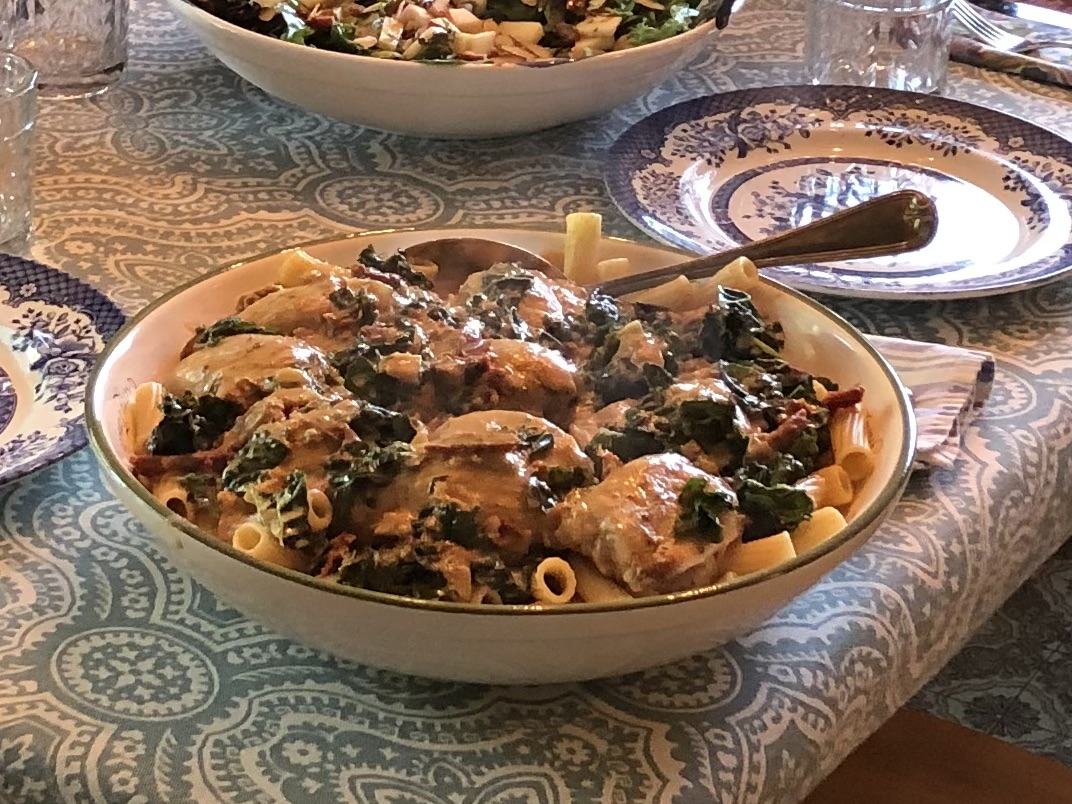
And for dinner at our house, I made a chicken and pasta dish that keeps being a favorite, so I thought it was time to write about it. I found the recipe on Family Style Food. I like Karen Tedesco’s recipes because they are simple and quick to make! She calls this one her “30-Minute Chicken Dijon with Creamy Sauce“, although I am pretty sure it takes me about an hour to make.

In my kitchen!

I have only made a few changes to Karen’s recipe. The main change is the addition of sun dried tomatoes. They add such a wonderful zing of flavor and texture to the dish. Also, I add a lot more kale than called for; it shrinks down so you can really go to town with it. It adds a chewiness that I love, plus, it’s good for you! Finally, I use a stainless steel skillet instead of non-stick. You get lots of caramelization and browned bits on the pan that are good for de-glazing, which adds incredible depth of flavor to the sauce – you won’t get that with a non-stick pan. But, if you only have non-stick, you will still end up with something delicious. Make it next time your cousins are in town!

Rigatoni with Chicken, Sun Dried Tomatoes, and Kale

(Adapted from Karen Tedesco’s recipe)

  • 3 tablespoons (85 grams) Dijon mustard
  • 1 tablespoon (15 ml) fresh lemon juice (about 1/2 lemon)
  • 1/2 teaspoon crushed red pepper
  • 1 tablespoon Italian herbs
  • 1 cup (125 ml) chicken broth
  • 1/2 cup heavy cream
  • 6 to 8 boneless skinless chicken thighs
  • kosher salt
  • 1 teaspoon freshly cracked pepper
  • 2 tablespoons (30 ml) extra virgin olive oil
  • 1/2 cup chopped onion (about 1/2 medium onion)
  • 2 tablespoons all-purpose flour
  • 4 cups chopped kale (I prefer Tuscan kale), stem removed
  • 1/2 cup sun dried tomatoes (I use the kind that are in olive oil)
  • 1 pound rigatoni or penne pasta
  1. Prepare some ingredients first to make things more streamline… chop your onions, remove stem from kale and chop coarsely, juice your lemon. Set all those things aside.
  2. In a small bowl, mix the mustard, lemon juice, crushed red pepper, and Italian herbs. Set aside.
  3. Measure out the cream, the chicken broth, and sun dried tomatoes, and set those aside as well. If you have been avoiding using a “mise-en-place” (prepping all of your ingredients before starting), maybe now’s the time to give it a try. It will make this recipe much easier.
  4. Heat olive oil in 12-inch stainless steel skillet over medium-high heat.
  5. Pat the chicken thighs dry with paper towels, then season with salt and pepper.
  6. Place chicken thighs in hot skillet smooth side down and cook for 2 minutes, then flip and cook for 2 minutes more. Remove chicken to a large plate and set aside.
  7. Add the onion to the pan and cook, stirring, until soft: about two minutes.
  8. Pour in just 1/2 cup of the chicken broth, stirring with a spatula to scrape up the browned bits. Sprinkle the flour on top and stir to combine. This will thicken quickly!
  9. Stir in the Dijon mixture and the remaining 1/2 cup chicken broth. Add the chicken back to the pan, smooth side up, along with any juices. Cover the skillet and lower the heat so that the sauce is at a gentle simmer. Cook for 15 minutes, adjusting heat as necessary so the sauce remains at a simmer – you don’t want it to boil!
  10. While chicken is simmering, boil your pasta, drain well, and put in large, shallow serving bowl.
  11. Once chicken has simmered for 15 minutes, uncover the pan and drizzle the cream over the chicken. Nestle the sun dried tomatoes between the pieces of chicken. Sprinkle about half of the kale over the top, cover and gently simmer for a few minutes (it should be a very slow simmer, a bubble every now and then, or else the sauce will split). Add the rest of the kale, nudging it down into the sauce, and cover and simmer for a few more minutes.
  12. Taste for seasoning; you can add salt or pepper, but I prefer to let my guests add their own salt and pepper if necessary. The sauce is already quite flavorful! Place the chicken pieces over the cooked pasta, then pour the sauce over the top, scraping up anything that is sticking to the bottom of the pan. Serve with grated parmesan cheese, a good crusty bread, and a simple salad of mixed greens. Serves 6. Enjoy!

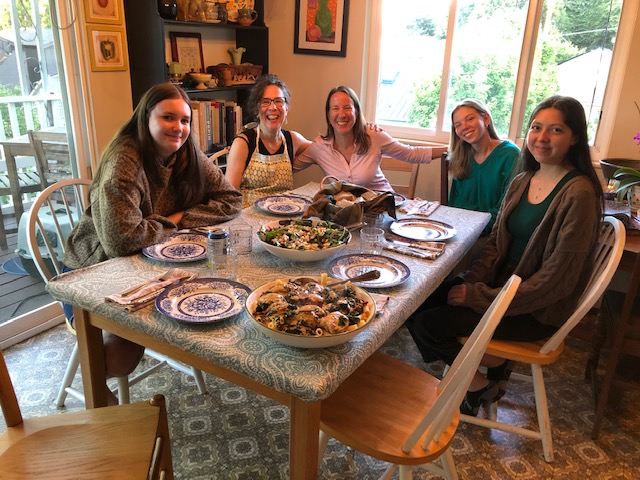
And just for fun, another picture of me with my sweet cousins.

Me, Valerie, and Katia enjoying the sunset on the Puget Sound.

Posted in Dinner, Fun in the kitchen! | 7 Comments

Old Fashioned Cocoa Brownies

I’m not sure why I haven’t blogged about these brownies before. They are the brownies I grew up with, and they are lovely. Very homey and simple, and just using ingredients I am sure to have on hand.

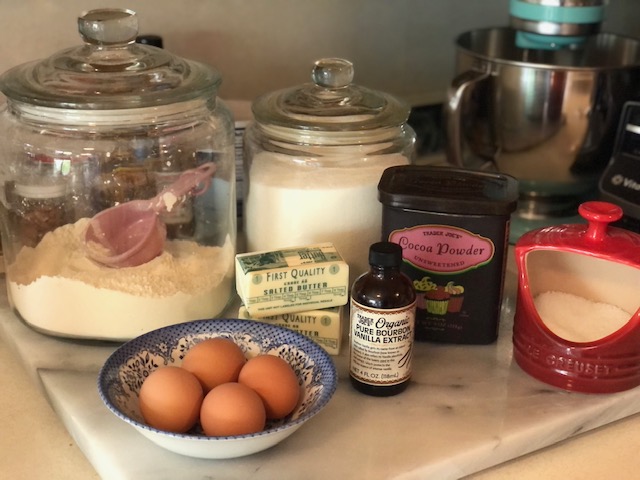
Just a few ingredients! (I forgot the powdered sugar, just one cup.)

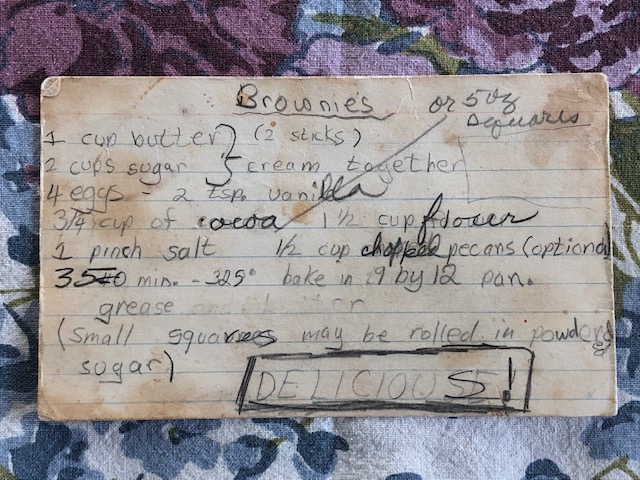
Well, I actually do know why I haven’t written about these brownies. The recipe leaves lots of room for error. I remember a conversation from long ago, where my sister Jane and one of her groovy friends were discussing these brownies, and it went something like this:

“Bake them properly, and everyone will bow down to you; over-bake them, and you will be shunned!”

I never forgot it, and have had both experiences over the years.

Original recipe written out by my sister Jane, with corrections by my Mom. Priceless.

These brownies were at just about every family celebration, and certainly at potlucks and other gatherings. I remember them piled high on a serving platter, and also remember sneaking one or two whenever possible. We nicknamed them our “trick” brownies, because if you took a bite and breathed in at the same time, the powdered sugar would make you cough. We kids got a big kick out of watching unsuspecting guests do this very thing.

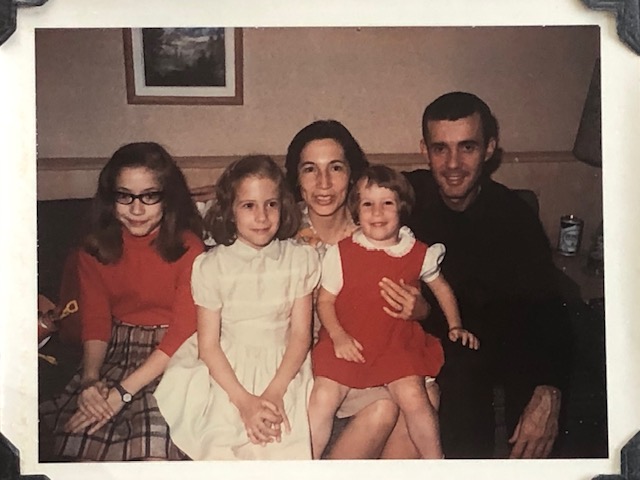
From left to right, my sisters Linda and Jane, my Mom, me, and my Dad.

So now, decades later, I’ve decided to find a surefire way to not over-bake these brownies, so that they are delicious every time. I borrowed a baking technique from Alton Brown, and found that his cocoa brownies were quite similar to ours, although they have more than twice the amount of cocoa! Using his technique, the brownies come out moist and cakey/fudgey; they melt in your mouth. The only drawback is that if you are a fan of the chewy brownie edges, you won’t get those here. Pretty much the entire batch bakes up evenly. You have been warned.

Old Fashioned Cocoa Brownies

  • 1 cup (228 grams or 2 sticks) salted butter*
  • 2 cups (400 grams) granulated sugar
  • 4 large eggs
  • 2 teaspoons vanilla
  • 1 1/2 cups (190 grams) all-purpose flour
  • 3/4 cup (82 grams) cocoa**
  • pinch salt
  • 1/2 cup (or more) Ghirardelli’s semi-sweet chocolate chips (optional)***
  • 1 cup powdered sugar for rolling
  1. Preheat oven to 300°F
  2. Grease an 8″ x  8″ or 9″ x 9″ square baking pan****. Line with parchment paper with overhang on two ends. Grease the parchment paper. (I use unsalted butter for greasing.)
  3. In a small sauce pan, heat butter until mostly melted. Remove from heat and stir until all the butter is completely melted. (You can also melt the butter in a glass bowl in microwave oven. Only heat until the butter is partially melted. It will melt completely with a bit of stirring.) Pour into large bowl and add sugar. Beat with electric mixer or stand mixer for about three minutes, until creamy.
  4. Add eggs one at a time, beating after each addition until well combined. Beat in the vanilla.
  5. Sift together the flour, cocoa, and salt. Add this to the wet ingredients and mix on low just until there are no dry bits. Then use a spatula to finish mixing, making sure to scrape the bottom of the bowl so everything is well combined.
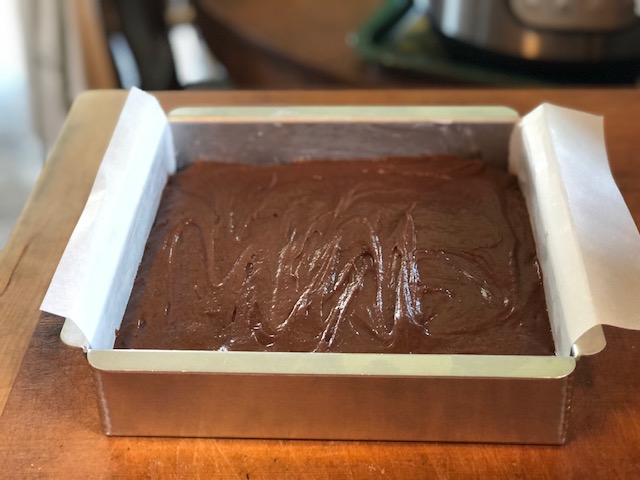
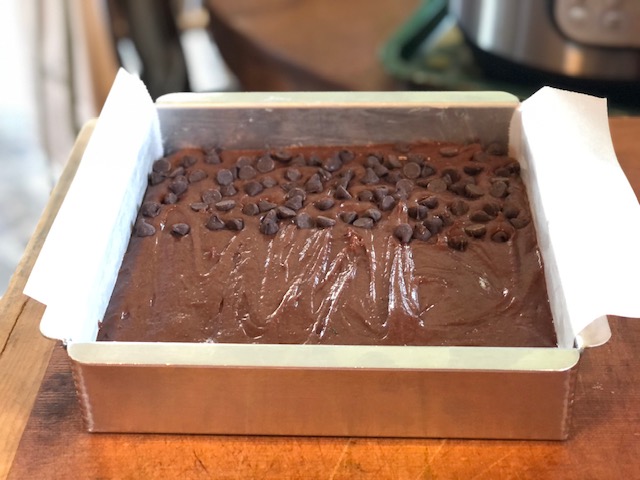
  6. Pour into prepared pan and smooth the top with spatula. At this point, you can sprinkle the top of the batter with the chocolate chips. This is optional!
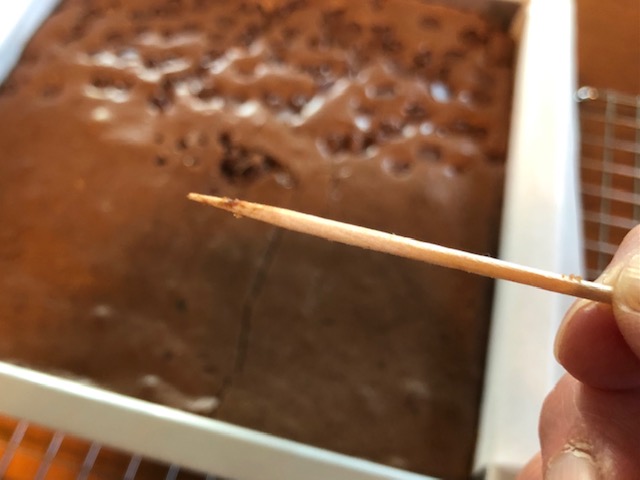
  7. Bake on center rack in preheated 300° oven for 15 minutes. Remove from oven and let rest for 15 minutes (this allows the heat to spread more evenly, for even baking). Put back in the oven and let bake for an additional 30 (9″ pan) to 45 minutes (8″ pan). There are two different ways to test for doneness. If using the toothpick test, toothpick should come out with a crumb or two, but should not be wet. If using an instant-read thermometer inserted into the center of the brownie (don’t let it touch the bottom of the pan), the temperature should read 195°F. Do not over-bake!!!
  8. Let brownies cool completely in pan, then cover well and refrigerate for a couple of hours, or overnight. When ready to cut the brownies, take a sharp knife and run along the sides of the pan that are not lined with parchment. Now, holding onto the parchment paper, lift out brownie. Cut the edges off (about 1/2″) and cut into 1 1/2″ squares and roll in powdered sugar, tapping or rubbing off any excess. Store in airtight container at room temperature, separating layers with parchment paper. If you leave a bit of space between the brownies, they will acquire their own sort of “crust”, which is very yummy! These brownies are better after a day or two, but are still delicious on day #1. Makes approximately 25 brownies if using an 8″ x 8″ pan, and approximately 36 brownies if using a 9″ x 9″ pan. These are small, almost like cubes, making it easy to eat more than one. Enjoy!

Notes:

*If you use unsalted butter, add 1/2 teaspoon table salt to your dry ingredients. I chose to use salted butter for these because I’m guessing that is what we used when I was a kid. Also, I opted for melting the butter, which diverges from the original recipe.

**I have been using Guittard Natural High Fat Cocoa Powder because it is so delicious and really adds to the flavor, but you can use any unsweetened natural cocoa powder you have handy. I do not recommend Dutch processed cocoa, as it will impart a more bitter-sweet flavor.

***I decided to try making some of the brownies topped with Ghirardelli’s semi-sweet chocolate chips. This is not at all traditional for our childhood brownies, but I was trying to reproduce a brownie that was very popular during my college years, and I do believe it works. The Ghirardelli’s are perfect for this, as their flavor is not too strong, and the chips are just the right size. If in doubt (like I was), just try half of the batch with chips, then you can decide which kind you like better. When I asked Matthew which he liked better, he said something very sweet and adorable, which I can’t remember now, but basically that both are perfection.

****I initially baked my brownies in an 8″ x 8″ square pan, which makes for a very tall brownie. It took all of the 45 minutes for the final bake, but I always start testing much sooner. If you don’t want your brownies too tall, use a 9″ x 9″ square pan, and maybe start testing a bit sooner. For me, the 9″ x 9″ pan takes about 35 minutes for the final bake, and I find that those brownies are plenty tall! Our family recipe card says to use a 9″ x 12″ pan… I don’t think they make those anymore!

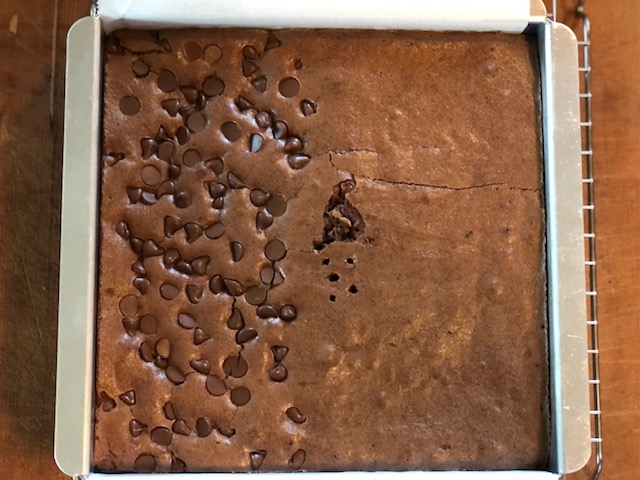
The parchment paper makes for easy removing of the brownie.

I experimented here: half with chocolate chips and half without.

I gouged the center with all of the testing, but it will get covered with powdered sugar 🙂

This toothpick says brownies are done: a fudge-y center – not wet, but not completely dry either.

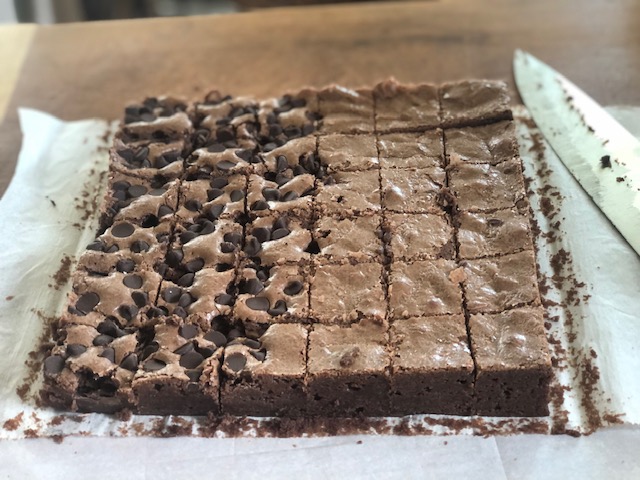
I cut off about a half inch of the edge (chef’s treat) and then cut into 36 squares (this one is a 9″ pan).

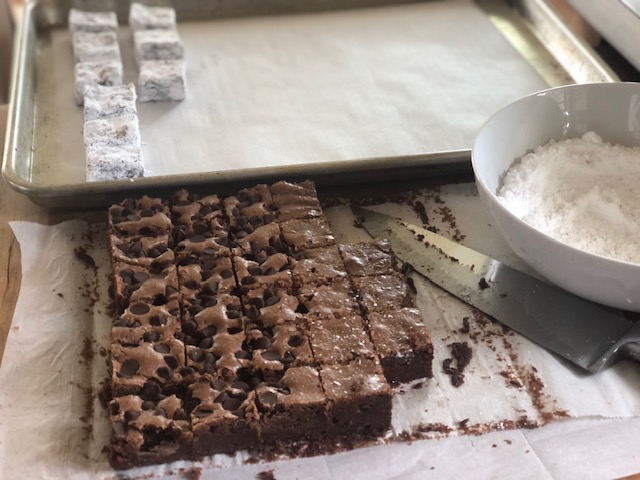
Roll all sides of brownie in powdered sugar; this is therapeutic, kind of like meditation…

From the 9″ pan, it makes 36 squares, plus the edges, of course.

Store in layers of parchment paper. The recipe makes a lot more, but, well… taste-testing!

These are very tall! Maybe some as tall as 1 1/2″? (from the 8″ pan)

Posted in Desserts, Fun in the kitchen! | 7 Comments

Two Pan Sourdough Bread

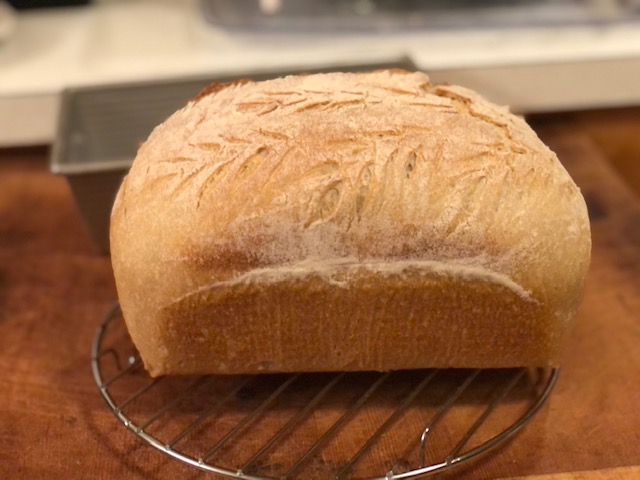
Lately, this is how I’ve been making my sourdough bread. It’s really tall!!! And I never get tired of pulling that top pan off and seeing the amazing rise that has happened.

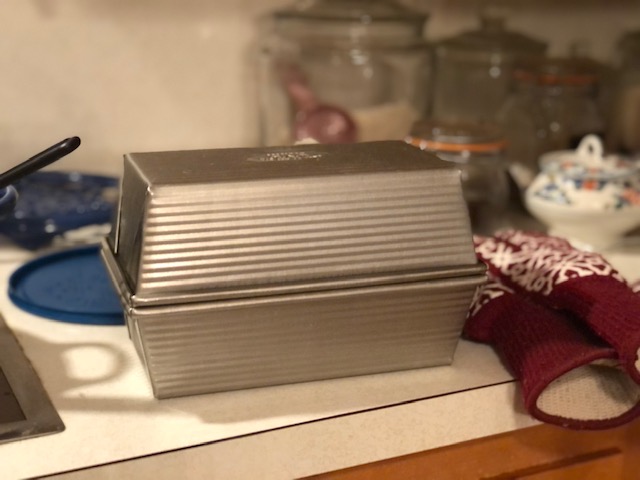
This time I wanted a sourdough sandwich loaf that was not dense or too soft. So I decided to make a standard sourdough loaf, and treat it the same as an “artisanal” loaf, but just bake it in a loaf tin with another loaf tin on top to create that steamy environment, which encourages a better rise and a lovely, thin and crispy crust.
The result is a tall and gorgeous sandwich loaf!

And here is the crazy part. If you want a tall round loaf, you can use two round cake pans and you will get a super impressive, festive creation. I can hardly get over it!
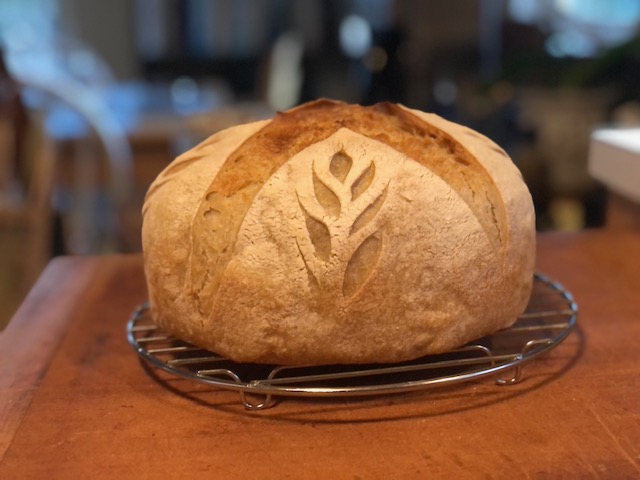
Yes, that’s correct. I made the above loaf by baking it in a cake pan with an inverted cake pan on top! I brought it to a holiday party and everyone loved it – so beautiful and unusual!****
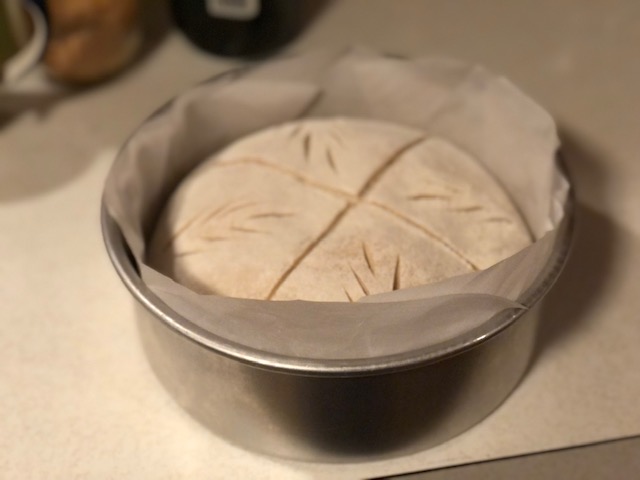
So you can take your regular sourdough bread recipe and use your loaf pan or cake pan as both a proofing and baking vessel. I love the simplicity of it, and I love how tall and gorgeous the loaves are. I’m sure I’m repeating myself by now. And if you’d like to know what my recipe is, here you go.

Two Pan Sourdough Bread

  • 340 grams filtered water, room temp
  • 50 grams active bubbly starter
  • 30 grams (2 tablespoons) olive oil (for softness)
  • 500 grams bread flour*
  • 9 grams (1.5 teaspoons) kosher salt

Day #1

  1. (Before making this bread, you will want to feed your sourdough starter a couple of times to make sure it is good and active… maybe once every twelve hours, including the night before you want to make your bread.) In the morning, in a medium bowl, mix 50 grams of your active starter with 340 grams water and 2 tablespoons olive oil. Whisk together until it looks milky and the starter is well incorporated.
  2. Add the flour and salt, and mix with a wooden spoon or dough whisk until there are no dry floury bits. The dough will look shaggy.
  3. Cover the dough and let rest for about an hour.
  4. After the dough has rested, mix the dough until it is smooth and springy: using a slightly wet hand (I keep a bowl of water handy), grab the dough from the side of the bowl and press it into the center. Rotate the bowl and continue to grab and press until you’ve gone around a couple of times. I really go to town on this, so maybe I stretch and fold over the dough about 16 to 20 times! This should take maybe about a minute. The dough will become more elastic and springy and smooth rather quickly. Flip the dough over in the bowl (smooth side up), cover the bowl with plastic wrap or similar covering, and leave on your counter.
  5. After about half an hour, using a bowl scraper or spatula, scrape all along the side and bottom of the bowl to make sure the dough isn’t sticking. With wet hands, scoop up the dough from the middle, letting the dough hang and stretch. Gently release the dough into a pile and rotate the bowl one quarter turn. Repeat, scooping up the dough and letting it hang and stretch. I sometimes jiggle it to encourage it to stretch a bit more. Tuck the sides of the dough under to make a nice round ball, then cover the bowl and leave on the counter. These are called coil folds, and they will help develop the gluten in the dough, giving the finished bread a nice structure. You can come back and do another set of folds in about a half hour if you like. That’s about as many as I ever do. Then leave the dough covered for anywhere from four to six hours, or until it has almost doubled in size, and has a bubble or two on the top (this varies depending on kitchen temperature, strength of starter, flour used, etc). Keep an eye on your dough because you don’t want it to rise too much! You’re just looking for the dough to be a little airy and jiggly, but you don’t want it huge and sloppy.
  6. Once the dough has almost doubled in size, gently scrape the dough out onto a lightly floured work surface using a spatula or bowl scraper. It is time to preshape your dough. Take your fingers and slide them under the sides of the dough and gently stretch the dough out a bit to make a large circle. Fold the sides of the dough into the center, starting at one side and continuing until you have gone all the way around, brushing off any excess flour as you go. Flip the whole thing over with the assistance of a bench scraper or bowl scraper. The dough will be “smooth side up”. Now cup the dough with your hands and draw it towards you, pressing slightly under as you go. Rotate the dough a quarter turn and repeat. Do this several times, but gently! You don’t want the dough to tear. You want the dough to be evenly round, and to feel taut and a bit springy. Once it is shaped nicely, cover it with the bowl it was just in, and let it rest for a half hour.
  7. While the dough is resting, get your 9″ x 5″ loaf pan** (size is important here, as a smaller loaf pan won’t do). Cut a piece of parchment paper to fit into your loaf pan and up the sides with a bit of overhang. You can bypass the parchment by greasing your loaf tin… I prefer parchment, which I reuse many times. After your dough has rested for about a half hour, lightly flour the top of the dough and flip it back over using your bench scraper. Slip your fingers under the dough and stretch it out to a rectangular shape. Lightly flour your finger tips and, acting like you are playing the piano, gently dimple the dough. This helps to minimize large holes in your bread. Take one short side and fold it partway over. Then take the other short side and fold that over, like you are folding a letter. Does anyone do that anymore? Now with the short end facing you, roll the dough up like a cinnamon roll, ending up with the seam side down. Pull the spirally ends over to clean things up and tuck under. Carefully pick up your dough with the assistance of a bench scraper or bowl scraper and place into your parchment lined loaf pan, seam side down. Cover with a shower cap style cover or plastic wrap and place in fridge to let rest and rise overnight***.

Day #2

  1. You can get started any time you feel like it. When you are ready, preheat your oven to 450° for about twenty minutes.
  2. Once the oven is preheated, take your bread dough out of the fridge. Remove the covering. Your dough should have risen to mostly fill the pan and rise about an inch above at the highest spot. Sprinkle your dough with a bit of flour and smooth it out with your hand. Using a sharp knife or razor blade, make a big slash about 1/4 inch deep along the long side of the loaf (this is called scoring). If you wish, you can cut some decorative designs making the cuts shallow, about 1/8 inch deep.
  3. Now take another 9″ x 5″ loaf pan identical to the other one, and turn it upside down to cover the dough. It should act like a lid. I like to tuck the parchment paper in toward the loaf before doing this, so it is all tucked inside. If you choose to grease the pan instead of using parchment, you will also need to grease the sides of your second pan. Put the whole thing into your preheated 450° oven on the middle rack. Bake for 20 minutes, then turn your oven down to 425° and bake for 30 more minutes, keeping the top pan on.
  4. Now take the whole thing out of the oven and take the top pan off. The loaf should have risen a lot! But the color will be pale. Pop it back into the oven without the top pan and let it bake for up to ten more minutes, until it is the color you like.
  5. Remove from oven, and tip the bread out of the pan. (Bread should be fully baked, but if in doubt, tap on the bottom of the loaf and it should sound hollow. Also, internal temperature should be somewhere between 205° and 210°.) Place bread on cooling rack and let cool completely – at least two hours – before slicing. Enjoy!

Notes:

*I have been using Cairnspring Mills bread flour, which is local here in the Seattle area. When not available, I use King Arthur brand bread flour. Probably any good bread flour will do. I recommend finding a local flour for freshness and flavor.

**You will need two 9″ x 5″ loaf pans – same brand. I recommend the USA Pan, but really, as long as you line your pan with parchment paper, any 9″ x 5″ pan will do. Just make sure you have two identical pans so that the top pan with fit well on top of the bottom pan.

***Once the dough is shaped and in the pan, you can skip the overnight rise and choose to just let the dough rise on your counter and you can bake the bread once the dough has risen about 1 inch above the rim of the pan, (which for me and my kitchen takes a couple of hours). It’s up to you. This is a nice option for a same-day bake. I do this often, but I do find that the dough is easier to score when it is cold from the fridge, and the longer overnight fermentation adds a nice depth of flavor. Either way the bread is delicious.

****If you decide you want to try this using round cake pans, what I do is I use an 8″ cake pan that is 3 inches tall for the bottom, and then you can use either a 2″ or 3″ tall cake pan for the top. When shaping your bread, just do a repeat of the first shaping for the final shape and place in parchment lined cake pan seam side down. Everything else is exactly the same!

Here are some photos of the process. Since many of the photos were taken early in the morning, the lighting wasn’t great. Sorry about that! But I still wanted you to have a visual.

Mix water, oil, and starter.

Add flour and salt. Don’t forget the salt!
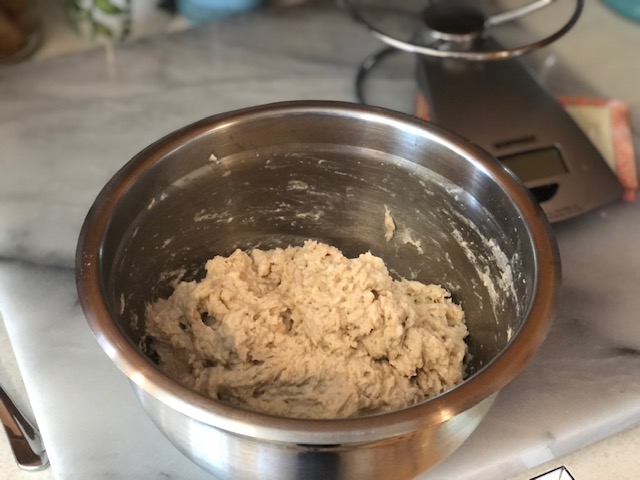
Mix into a shaggy dough.
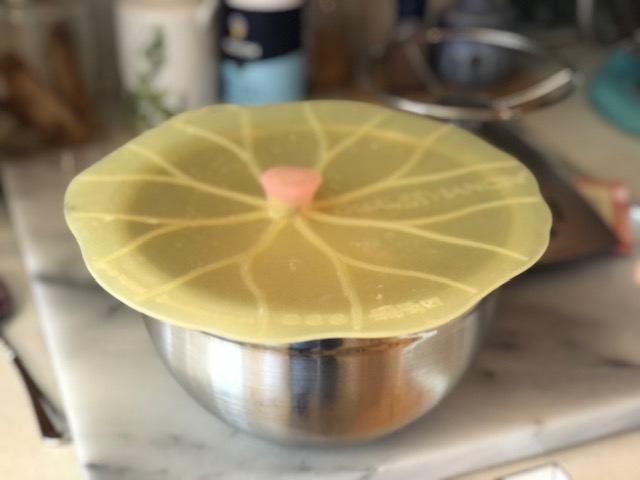
Cover and leave on counter for an hour.

After an hour, stretch and fold! Pull dough from the side, stretching it.

Fold it into the middle and press down.

Rotate bowl and do this again.
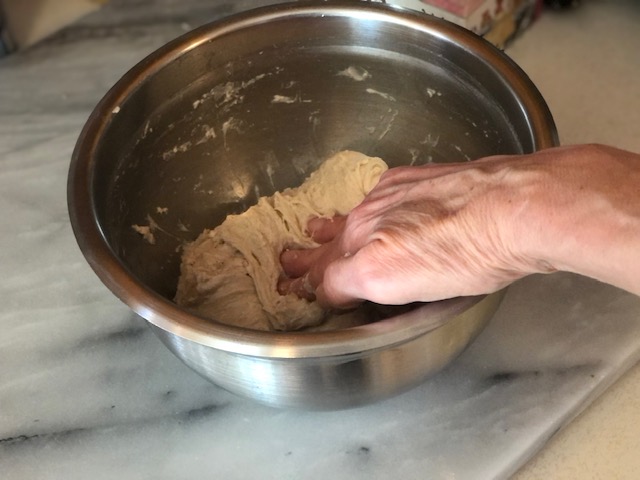
Fold over.

Keep going until the dough is springy and smooth, maybe 16 to 20 times.
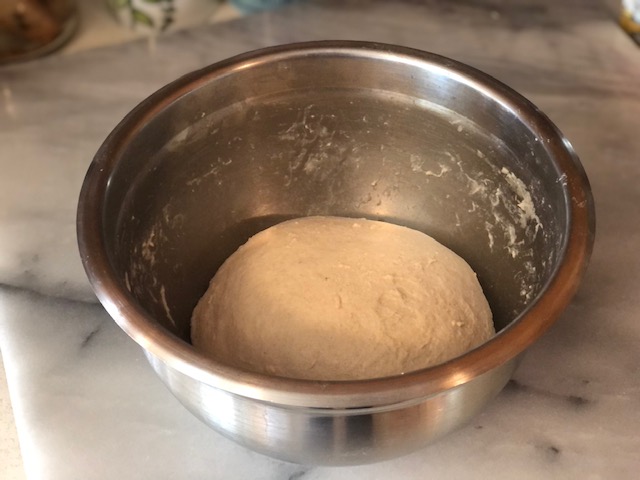
Flip over so the smooth side is facing up.

Cover and let rest for a half hour.
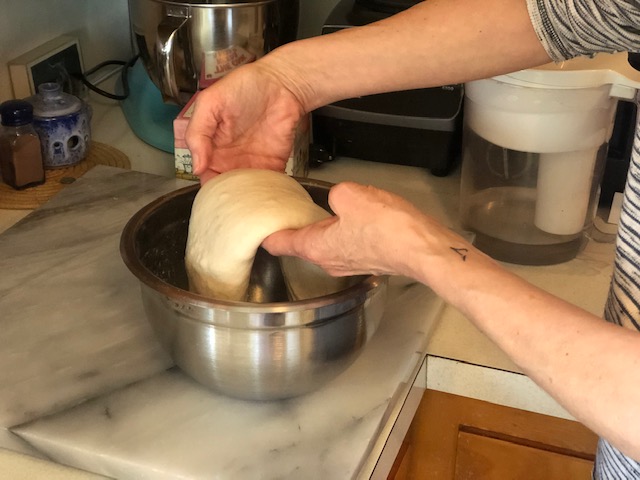
With wet hands, grab dough from middle and lift. This is a coil fold.

Let the dough stretch and then place the dough back in the bowl letting it fold onto itself.
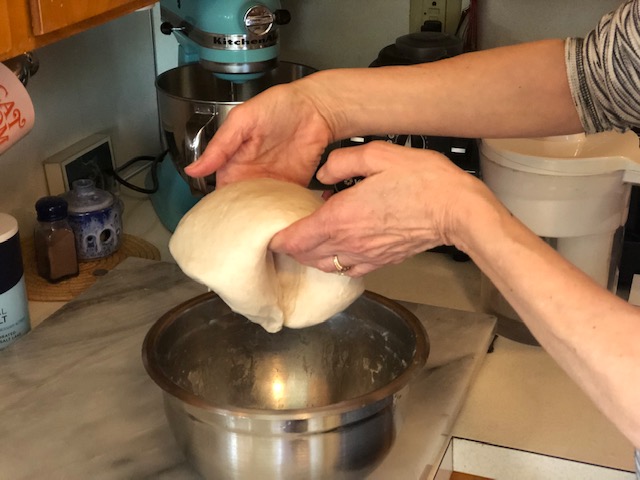
Rotate the bowl and quarter turn and do it again. The dough will not stretch very much this time.

Tuck the dough edges underneath to make a nice round ball.

Cover and let rest for a half hour and repeat the coil folds. Let dough rise covered for four to six hours.

After about four hours, dough has risen, is slightly jiggly and there are some small bubbles at the top.

Scrape dough out onto lightly floured surface.

Stretch and fold all the sides into the center, brushing off excess flour as you go.

Flip dough over and draw it towards you to add tension to dough. Rotate dough and repeat until you have a nice ball.
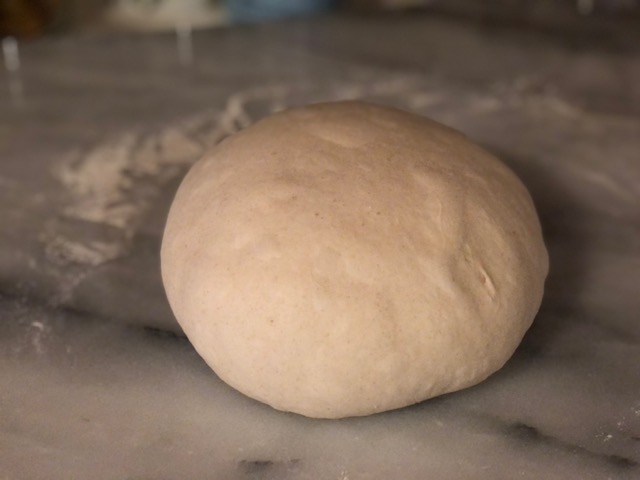
Should look something like this.

Cover with the bowl you were using and let rest for half an hour.
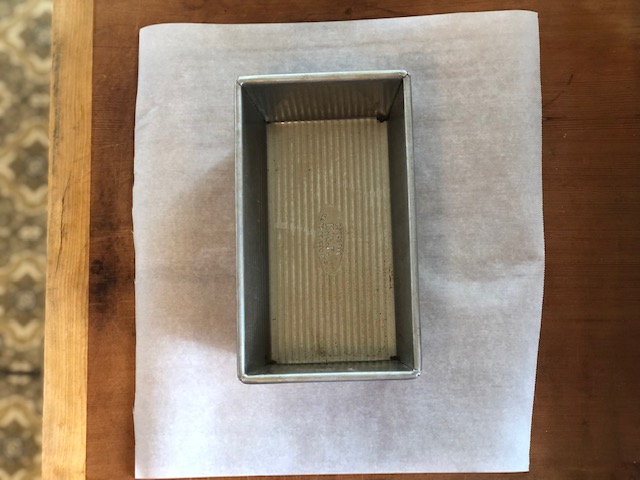
Time to line your loaf pan. Cut a 13″ x 15″ square of parchment.

Cut corners of parchment off.

Fold the four flaps making creases, and insert into pan.
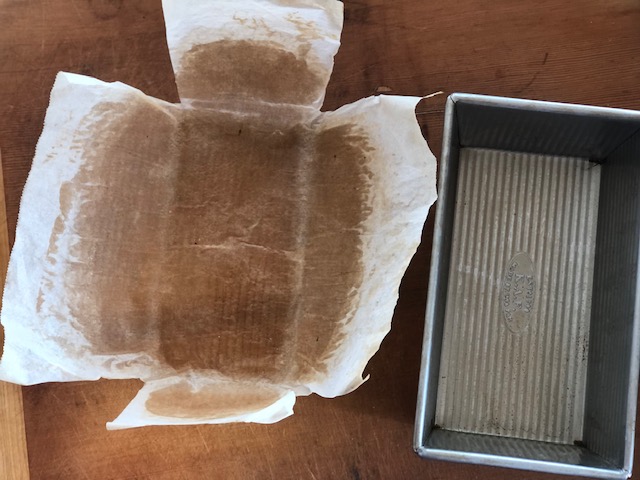
I reuse the parchment many times, as you will see in my upcoming photos.
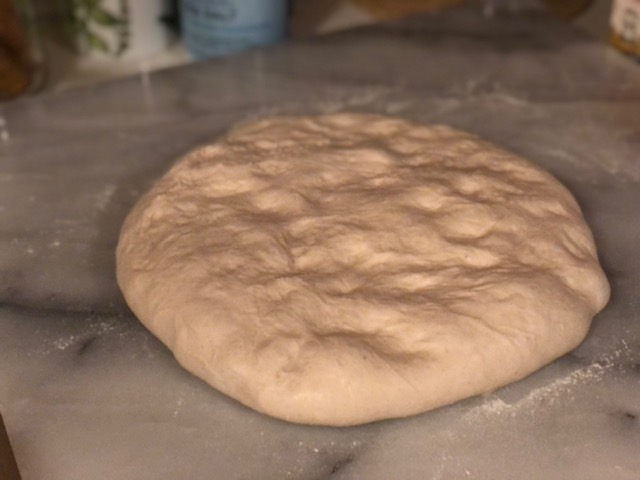
After dough has rested, lightly flour the top and flip it over onto lightly floured surface and dimple the dough with your fingertips.
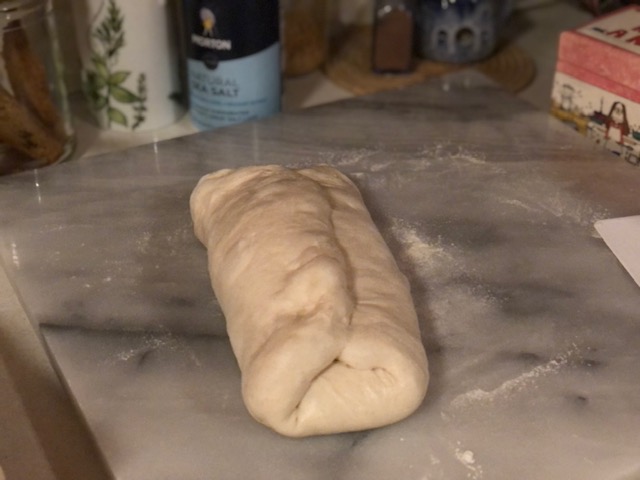
Pull corners to make rectangle shape, then fold each side over like folding a letter.
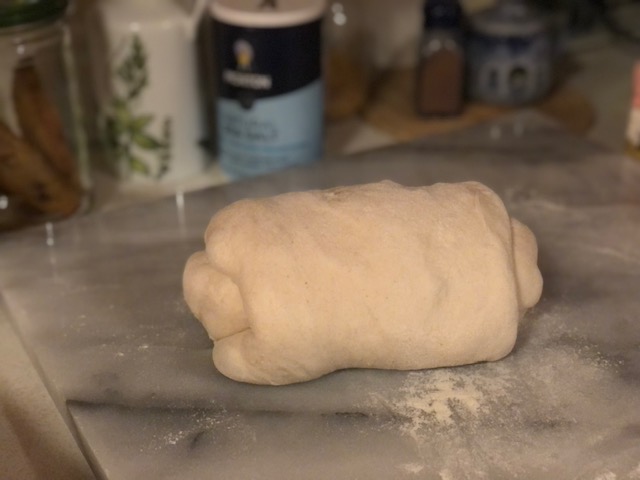
Starting with short end, roll the dough like a cinnamon roll. Yes, it looks weird.

Pull ends over and pinch and tuck to seal.

With the help of a bench or bowl scraper, place dough seam side down into your prepared loaf pan.
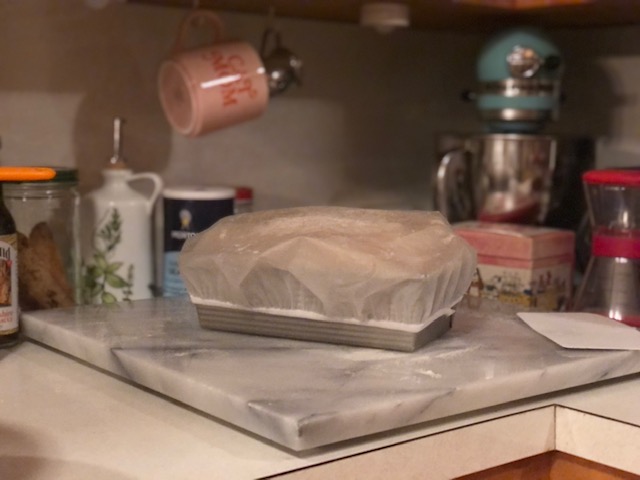
Cover and place in fridge overnight (or you can just let it rise on the counter for an hour or two).

Next day preheat oven to 450°. Here is the loaf the next morning filling the loaf pan nicely.
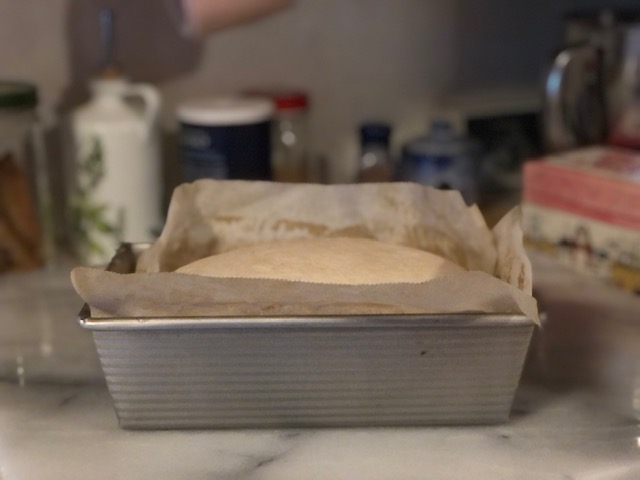
Here you can see that the dough has risen an inch or so past the top of the pan. It’s good to go!
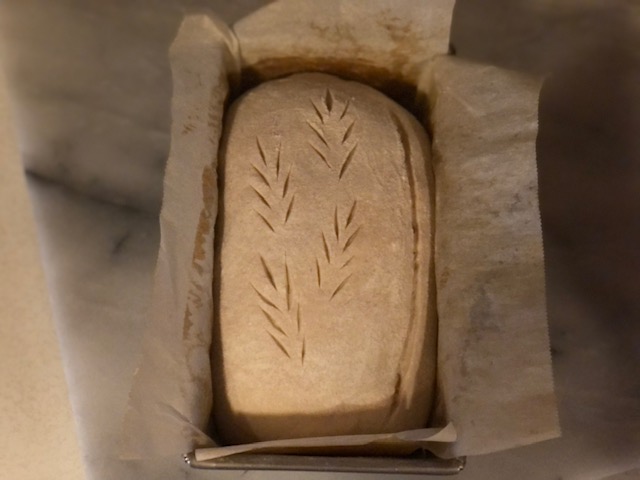
Sprinkle the loaf with flour and smooth it with your hand. Make desired decorative cuts, and a long deeper cut along the side.

My favorite implement for scoring is the lame (french for blade) on the left. Anything really sharp will do.

Tuck the paper along the sides of the loaf and top with your second loaf pan.
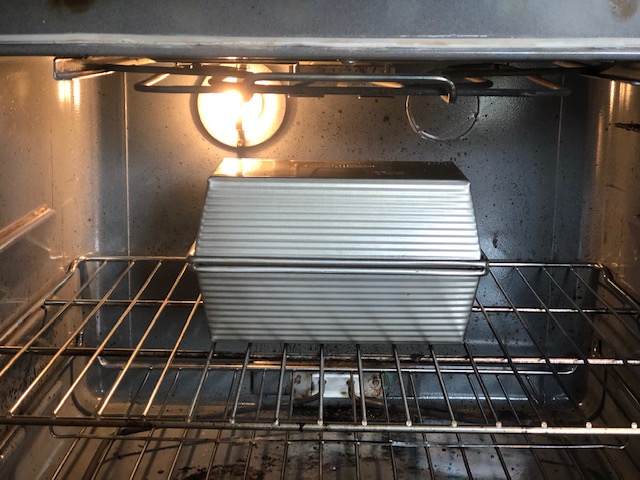
Bake at 450° for 20 minutes, then reduce temp to 400° and bake for 30 minutes more, keeping covered the entire time.

Now take the lid off and feel the joy. Bake for up to ten more minutes without lid to get the color you like.
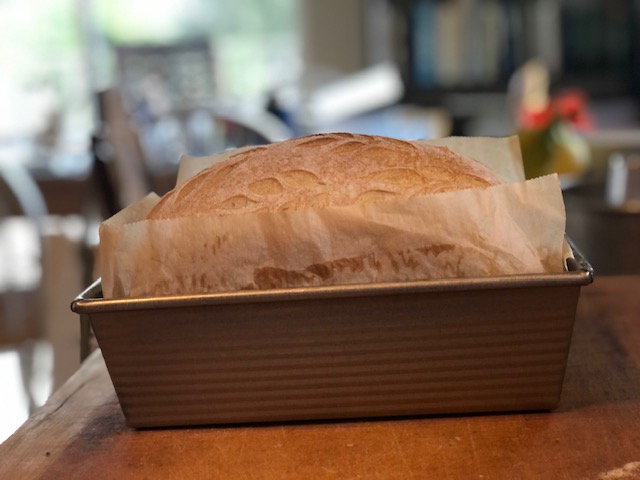
This is about right for me.

Take the loaf out and let it cool on a cooling rack for two hours before cutting into it.
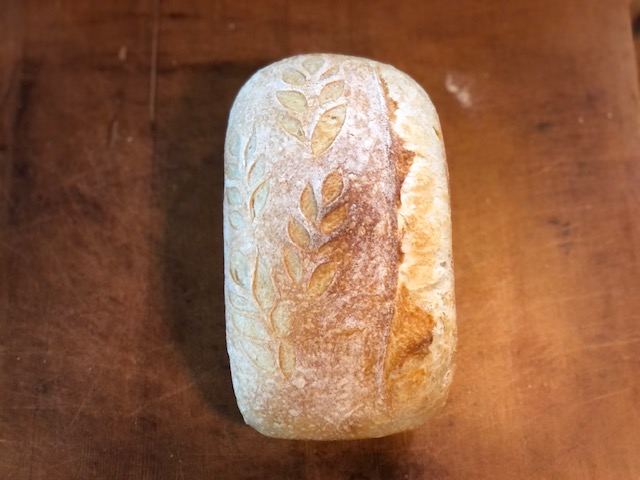
Yummy, beautiful, and great for slicing and toasting!

Posted in Breads, Fun in the kitchen!, Sourdough | 2 Comments

Chocolate Hazelnut Biscotti

I’ve been wanting to make chocolate biscotti for a while now. I’ve tried several different recipes, and I’ve finally landed on this one – it’s an adjusted version of these almond-anise biscotti, which are my favorite. One of the things I love about them is the heady aroma of anise, so I knew I’d need to include anise in these as well. When I made a chocolate version with almonds but no anise, Millie said, “It’s giving brownie“, which is a young person’s way of saying they taste like brownies. Haha. Now you know some new slang. I had to agree with her that they did kind of taste like brownies, so I put the anise back in, and also added some orange zest for a citrus kick. When Millie tasted one of those, she said, “It’s giving Nutella“! You know, the chocolate hazelnut combo? Well, I think they are giving deliciousness. I hope you agree.

Chocolate Hazelnut Biscotti

  • 3 cups (360 grams) all-purpose flour
  • 6 tablespoons (40 grams) good quality cocoa (high fat if possible)
  • 1 tablespoon baking powder
  • scant 1/2 teaspoon kosher salt
  • 1 1/2 cups  + 3 tablespoons granulated sugar
  • 10 tablespoons unsalted butter, melted
  • 3 large eggs at room temperature
  • 1 tablespoon vanilla
  • zest from one orange – about one tablespoon
  • 1 tablespoon freshly ground anise seed (use a mortar and pestle)
  • 1 cup toasted hazelnuts, coarsely chopped
  • 3/4 cup mini semi-sweet chocolate chips (Ghirardelli makes a nice mini chip)
  1. Line a cookie sheet with parchment paper and set aside.
  2. In a medium bowl, whisk together the flour, cocoa, baking powder, and salt.
  3. In a large bowl, using a wooden spoon, stir together the sugar and the melted butter. Stir in the eggs one at a time, then the vanilla, orange zest, and ground anise seed.
  4. Add the flour/cocoa mixture to the wet ingredients and stir to mix, until you see no more flour.
  5. Stir in the chopped hazelnuts and mini chocolate chips.
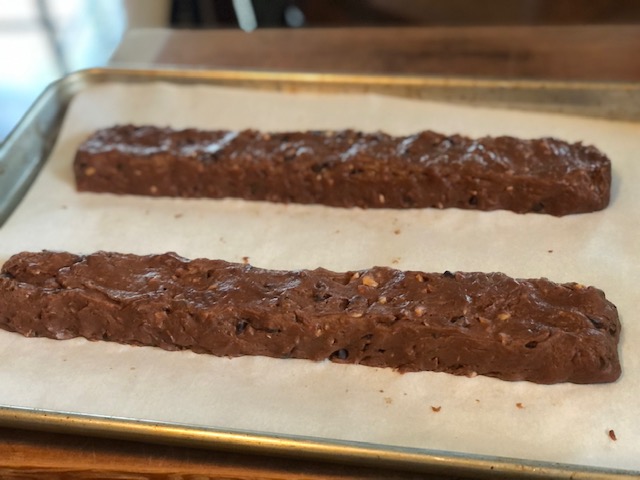
  6. Let the dough rest for about 15 minutes, then divide in half and form into two long logs on the parchment lined baking sheet. I do this by spooning dollops of dough in two lines, and then shaping with my hands. The logs should run the length of the baking sheet, and should be about 1 inch tall and 2 inches wide. Try to have about 4 inches of space between the logs.
  7. Chill the logs in the fridge for about half an hour.
  8. Preheat oven to 350°.
  9. Bake logs in preheated 350° oven on the middle rack for 30 minutes. Remove from oven and let logs cool on the pan on a cooling rack for 25 minutes. Leave the oven on!!!
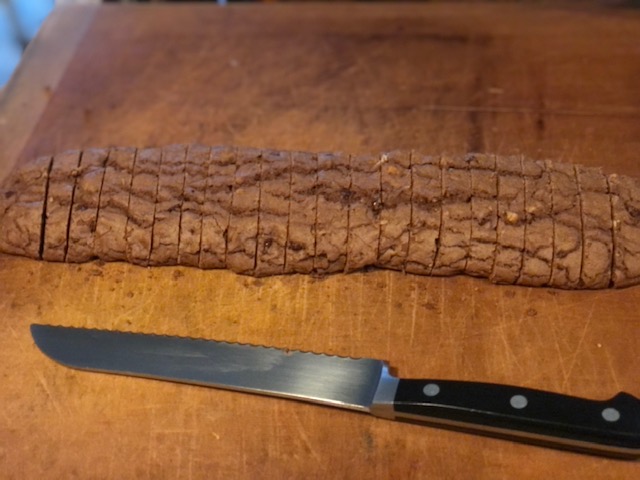
  10. After the 25 minutes of cooling time, carefully remove the logs from the parchment paper onto a cutting board. Discard the parchment paper. With a sharp serrated knife (I like to use a bread knife), cut the logs into 1/2″ slices using a firm, consistent sawing motion. With the other hand, hold the log in place as close as you safely can to the cut to keep the log from falling apart. Place the slices cut side down on the baking sheet (do this one log at a time) and bake for 12 minutes. (While they are baking, you can go ahead and slice the next log and put the slices on a second baking sheet.) When the 12 minutes are up, take the baking sheet out and carefully flip the slices over and put back in the oven for another 8 minutes. When they are done baking, remove from oven and place biscotti directly on a cooling rack. Now you can bake the second batch in the same way.*
  11. Once cookies are completely cool, store them in an airtight container. These biscotti are so much better after a day or two, I promise you, so be patient! And if stored properly, they stay crunchy and delicious for at least a month, and the flavor just keeps improving. Makes approximately 50 biscotti**. Enjoy!

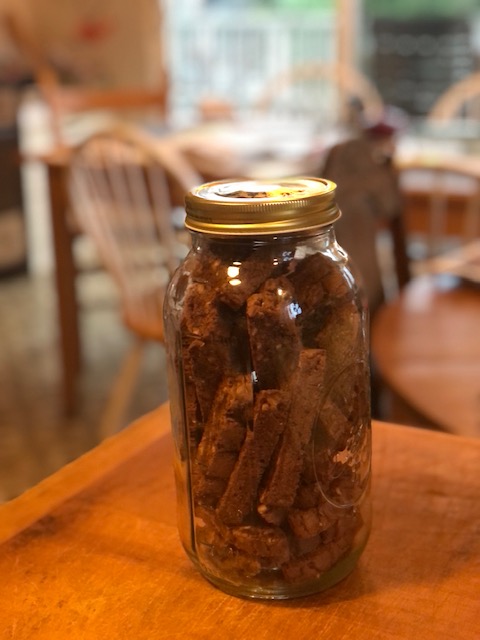
This 8-cup Ball jar makes a nice air-tight cookie jar.

Notes:

*The end pieces do not get twice baked. Those are set aside as a special treat :).

**One of the things I love about this recipe is that it is very easy to make a smaller batch. You can easily make 1/3 of a batch for a craving, or 2/3 of a batch if you’d like extras to have around for a while, which is what I did this last time, so I was able to fit all the cut biscotti on one baking sheet. Nice. Pretty much all the ingredient amounts are easily divisible by 3. A tablespoon equals three teaspoons by the way, but you probably already knew that. When I’m making these for holiday gifts, I make the whole recipe, but the smaller batches are quicker and more manageable.

Here are a few photos of the process:

Nice even logs (this is just two thirds of the recipe because I didn’t want to make the whole thing)

After baking for 30 minutes.

Nice even slices.

I’m surprised one of the end pieces is still sitting around!

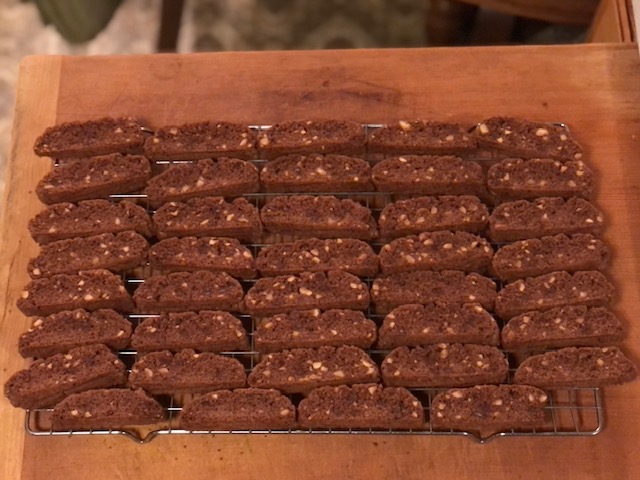
Ready to go in for a second bake. This is all the cookies from 2/3 of the recipe (both logs). Now you know why you’d need to do two trays for the full recipe.

Cooling. Remember, they are better after a couple of days!

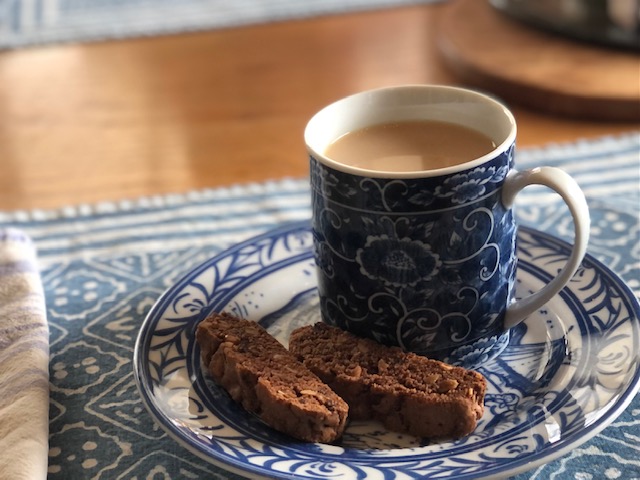
Coffee break!

Posted in Cookies, Desserts, Fun in the kitchen! | 4 Comments

Chocolate Cheesecake

I recently got together with my friends Jill and Deb for dinner, and we each made a part of the meal. I got to bring dessert – yay!

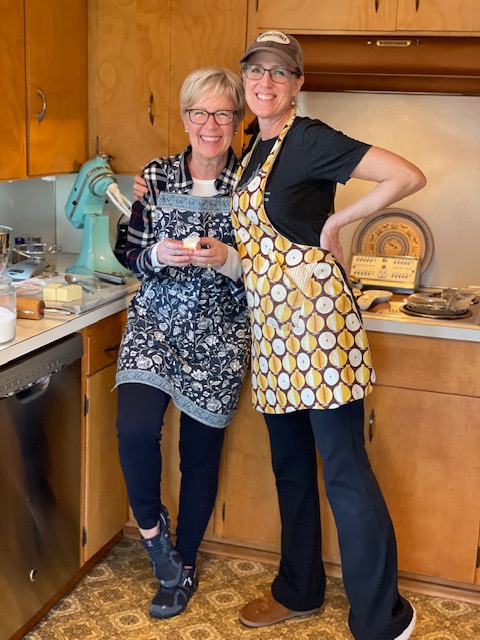
Deb and Jill in my kitchen, from a pie crust extravaganza a few years back.

A while ago, Jill mentioned that she didn’t like cheesecake, and I was convinced that she just hadn’t had the right cheesecake. Then later she told me that she tried a chocolate cheesecake at a local restaurant, and was pleasantly surprised at how much she liked it! I knew then and there that I had to make my favorite chocolate cheesecake for her to try.

Not a conventional way to make cheesecake, but it’s great for a smaller group!

This recipe comes from one of my absolute favorite cookbooks, The Vegetarian Epicure Book Two, by Anna Thomas. I’ve had it (as well as the first volume) since my college days, when I was actually a vegetarian. All of the recipes in Anna Thomas’ book are absolutely wonderful, and made me seem like such a good cook back in those days. All I had to do was follow the directions, and voilà! I’d end up with something delicious!

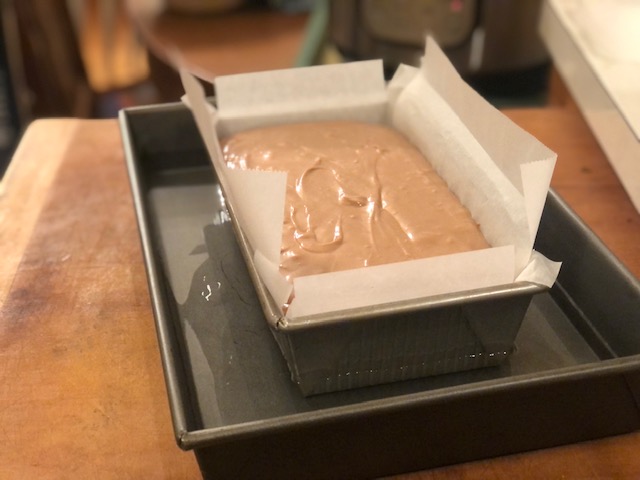
A water bath makes for even baking.

It had been so very long since I had made this cheesecake (at least 20 years) that I was a little concerned about how it would turn out, but I am now convinced that you can’t really mess this one up, which is a huge advantage: it’s easy to make, and difficult to screw it up. And you end up with a silky smooth, rich and delicious cheesecake! And it’s a tall cheesecake! I like my cheesecake to be tall. I just do.

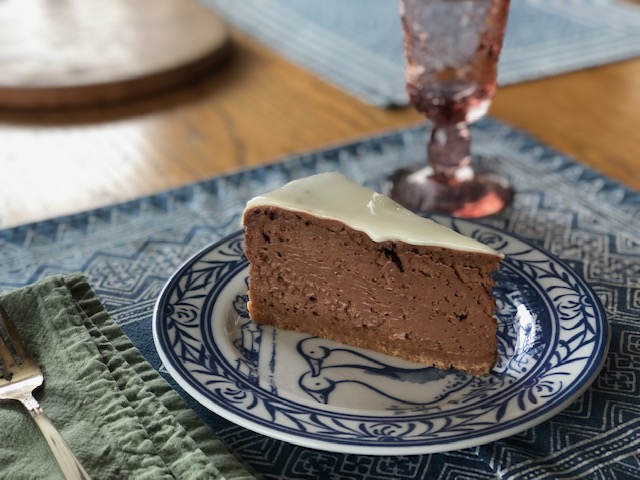
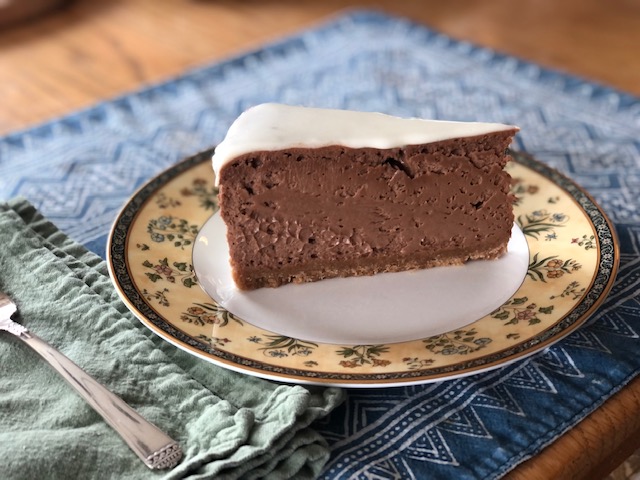
I mean, look how tall it is; it’s practically levitating.

So here is what I did. Since I didn’t want to make the full recipe in a large spring form pan that serves a million people, I made 2/3 of the recipe, and I followed different baking directions (from this recipe) to accommodate a 9″ x 5″ loaf pan size. That makes a water bath a lot easier, since there is no leaking when using a loaf pan. And the cool thing is, you can still cut the cheesecake to make the pieces look like they are from a traditional round cake. I really don’t want my cheesecake to be any other way. I need a wedge.

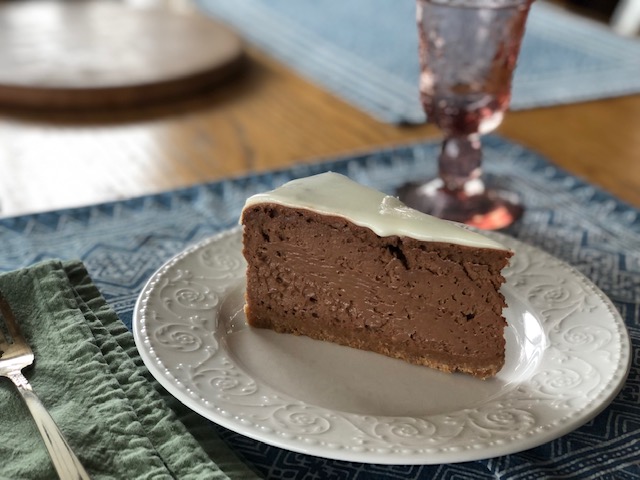
Yet another shot of this tall wedge of cheesecake! Different plates, same slice!

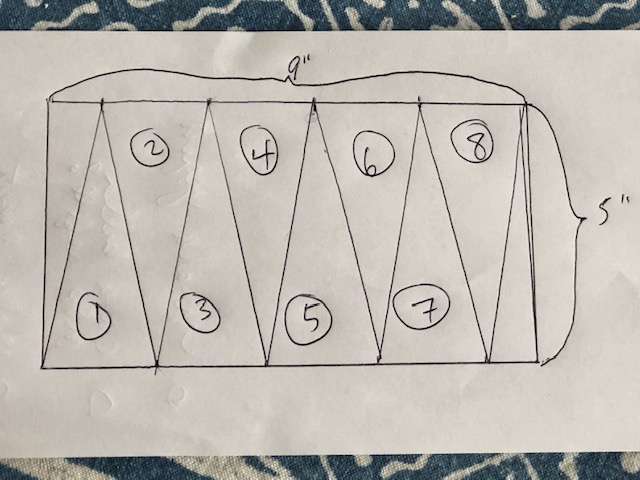
And here is a diagram of how to slice so you end up with 8 beautiful wedges, plus two extra small weird edge pieces. Somehow I sliced the pieces extra large for our girls’ dinner, so I didn’t end up with 8 pieces. Oh well. Nobody suffered.

Each piece should be 2 inches wide at the back.

Jill and Deb both loved the cheesecake and asked me for the recipe just as I made it in the 9″ x 5″ loaf pan, so here it is, with only a few minor changes. This cheesecake is best when made one day in advance.

Chocolate Cheesecake

(Adapted from Anna Thomas’ recipe)

For the crust:

  • 1 heaping cup fine graham cracker crumbs (about 10 whole graham crackers)
  • 2 tablespoons granulated sugar
  • 1/2 teaspoon cinnamon
  • 1/8 teaspoon kosher salt
  • 5 tablespoons unsalted butter, melted

For the cake:

  • 1 pound cream cheese (2 – 8 ounce packages) at room temp
  • 1 1/3 cup granulated sugar
  • 2 large eggs at room temp
  • 1 cup (150 grams) semi-sweet chocolate chips
  • 2 tablespoons heavy cream
  • 2/3 cup sour cream at room temp
  • 2 tablespoons dark rum
  • 1/2 teaspoon cinnamon
  • 1/2 teaspoon almond extract (optional, can also use less*)

For the topping:

  • 2/3 cup sour cream
  • 2/3 cup powdered sugar
  1. Preheat oven to 325° and line a 9″ x 5″ loaf pan with parchment paper, leaving some overhang on the long sides for easy cake removal.
  2. Stir dry crust ingredients together in small bowl, then add melted butter and mix until well blended. Press into the bottom of lined loaf pan as evenly as possible. Set aside. For a slightly firmer crust, you can pop it into the oven for 15 minutes, then remove and let cool for another 15 minutes.
  3. For the cake: in a large bowl, beat cream cheese on medium speed until fluffy. Gradually beat in the 1 1/3 cups sugar and eggs, stopping as soon as the mixture is perfectly smooth. It is important to not over-mix or use a higher speed, both of which can result in adding too much air to the batter, which will create bubbles and cause cracking. Set aside.
  4. Melt the chocolate with the heavy cream in a small saucepan, stirring until mixture is smooth. The mixture should not be hot, just warm enough to melt the chocolate. Mix this into the cream cheese mixture, along with 2/3 cup sour cream, on med-low speed. Add rum, cinnamon, and almond extract, if using. Mix for a minute or two more.
  5. Pour mixture into prepared loaf pan and smooth the top if necessary. Place loaf pan in a 9″ x 13″ baking pan, and fill the the baking pan with hot water about half way up the outsides of the loaf pan. Place the whole thing in your preheated 325° oven on the middle rack, and bake for approximately 55 minutes, until cheesecake is set. My cheesecake looked “set” after about 20 minutes, but I did let it bake for 55 minutes. With a full recipe in a round pan, the cake should jiggle just a teeny bit in the center if it’s done, but I’m not sure this applies to baking in a loaf pan. All I know is that 55 minutes was sufficient, and the entire top looked set, and the cheesecake was not overbaked! If your oven runs hot or cold, you’ll want to make adjustments accordingly.
  6. Once 55 minutes are up and cheesecake appears to be done, turn off oven, and leave cheesecake in oven for 15 minutes with door closed. After 15 minutes, take the whole shebang out of the oven, place on cooling rack, and let the cheesecake continue to cool in the water bath for another 30 minutes.
  7. Remove from water bath and let cool completely. Once completely cool, chill in the fridge, covered, for at least three hours, but for best results, chill overnight.
  8. When ready to serve, mix together the 2/3 cup powdered sugar with the remaining 2/3 cup sour cream until completely smooth. I recommend using a wooden spoon for this so you don’t end up with a lot of bubbles.  Set aside.
  9. Remove cheesecake from pan by carefully lifting by the parchment paper. You may need to loosen the sides first by running a thin knife between the pan and the parchment paper. Peel down the sides of the parchment paper, and transfer the cheesecake (without the parchment paper!) to a serving plate using a long, thin spatula or a bench scraper. Spoon the sour cream topping on top of the cheesecake, trying to keep it just on the top. Some may drip over the sides, but you don’t want it overflowing.
  10. To cut the cheesecake, get a container of boiling hot water and a very sharp knife. Dip the knife into the hot water, dry it, and make your cut. Wipe the blade clean with a paper towel and dip it into the hot water again for every cut, cleaning the blade each time. If you like, you can decorate the top edge with a couple of raspberries or strawberry halves, but really, it is perfect just as is. Enjoy!

Notes:

*I found that the almond extract was a little strong, but Deb and Jill loved it. You decide. I think next time I will reduce it by half. I’m pretty sure that when I made it regularly years ago that I skipped it altogether.

**You can certainly make the original cheesecake. You won’t regret getting the cookbook; it is seriously wonderful. You’ll have to get a used copy, as I am pretty sure it is out of print. I have just become a little obsessed with making a smaller cheesecake. I do have a smaller 6″ springform pan, but then the pieces of cheesecake would be short, and that’s a no-go for me. When you use a 9″ x 5″ loaf pan, your slices of cheesecake are the same size as if you had used a 10″ springform pan. It’s worth it. Please don’t use an 8 1/2″ x 4 1/2″ loaf pan. I’m pretty sure your cheesecake will overflow, and you don’t want that.

Sorry about the blurry photo! This is the prepared pan with crust.

Ready to go with water bath.

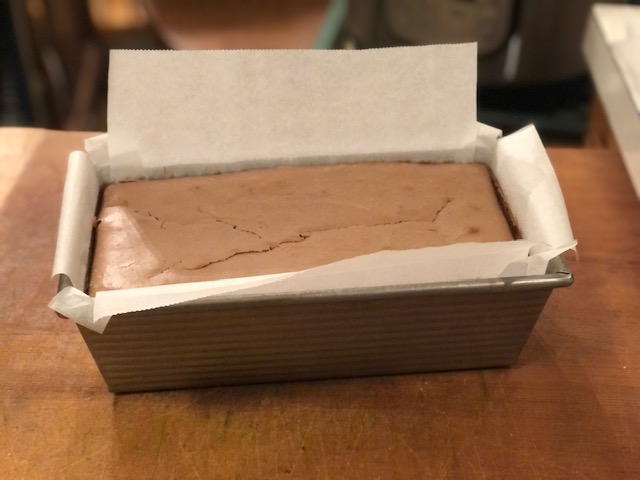
After baking and chilling. It’s a little cracked, but still so good!

Parchment peeled down. You can see there are some air bubbles. I’ll do better next time!

With the sour cream topping. I realized too late I should have moved it to a serving platter first!

So delicious! Still my favorite chocolate cheesecake.

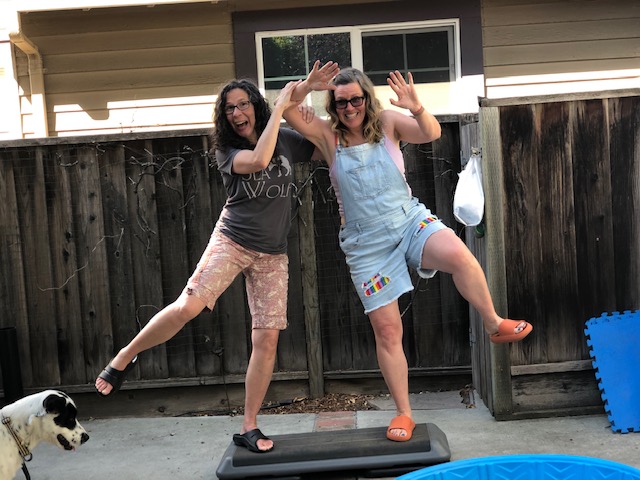
And just for funsies, me and Deb and Jill!

Posted in Desserts, Fun in the kitchen! | 4 Comments

Step Aerobics, anyone?

In my dance/workout studio with my cat Togy making a special appearance.

How can it be that I have not yet written about step aerobics??? I have been teaching step classes for many years, and it brings me so much joy. I love it when I’m having so much fun that I don’t realize I’m working out… well, I almost don’t realize I’m working out. That’s step aerobics for me; a super fun dance party with friends!

Doing a step aerobics demonstration at my kids’ school.

When the pandemic hit, I immediately took my classes online (thank goodness for modern technology!). I couldn’t believe we were able to continue “stepping” together without missing a beat… no pun intended.

A pop-up card my steppers made for me with screen shots from our online step classes.

I didn’t know how things would go, but my step classes are still going strong, even though the scary, early pandemic days are behind us. I pinch myself that I get to work out with such a great group of people. We all just keep showing up, which as you know is 99% of the battle when it comes to exercise, and I am a group exercise kind of gal; I really need others with me to motivate me and keep me accountable. Here I am with some steppers from this morning’s class. I talked some of them into staying after stretch so I could take a screen shot :).  I still get emotional when I think how this step class kept us going and connected during a time when we were all so very isolated. We needed things to still feel normal. This helped so much. And it still does.

These ladies mean the world to me.

So we’ve kept the group going online, and new people have joined, some who heard about me through word-of-mouth, some that are friends of steppers, and even sisters and friends in other parts of the country, which makes my heart extra happy. I just tell them that as long as they show up, I will keep showing up. And they keep showing up! It is really hard to find a good step class at gyms these days, but there are a lot of us out there that are completely hooked, and I, for one, am dedicated to keeping step aerobics alive and well and vibrant and fun!

And just for funsies (speaking of fun), here is a picture of me with my friend Stephanie. She and I grew up together, and although we live in different states now, we get to see each other and work out together four times a week! What?? How wild is that? It’s really more fun than I ever thought working out could be, and I feel emotional about that too.

Me and my bestie Stephanie, being silly in her backyard step space :).

And now you know that I am not only a nerd for baking, but I am also a nerd for step aerobics (to quote my kids). Are you a nerd for step aerobics too?

Posted in Health and Wellness, Musings | Tagged , | 16 Comments

Apple Crumb Bars

A couple of weeks ago, Millie and I went to Cafe Javasti for an after-doctor-appointment-treat. It’s on our way home, so we often go there, and they have such yummy everything! We got coffees and an apple oat jumble bar to split. If I had known how good it was going to be, I would have gotten two! Truly one of the best “crumb” type of desserts I have ever had, and it set me on a wild goose chase trying to reproduce it.
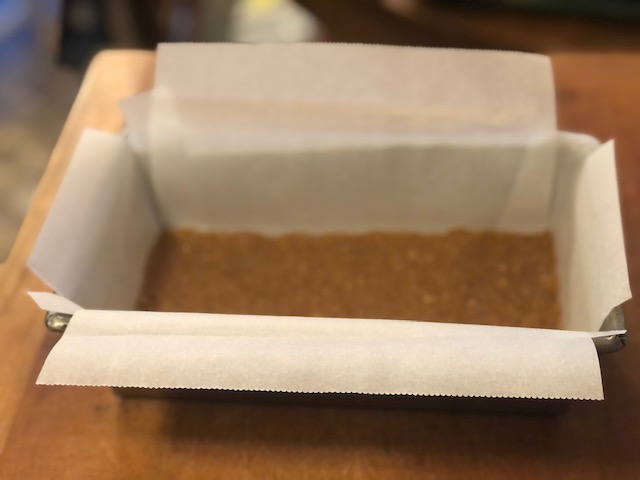
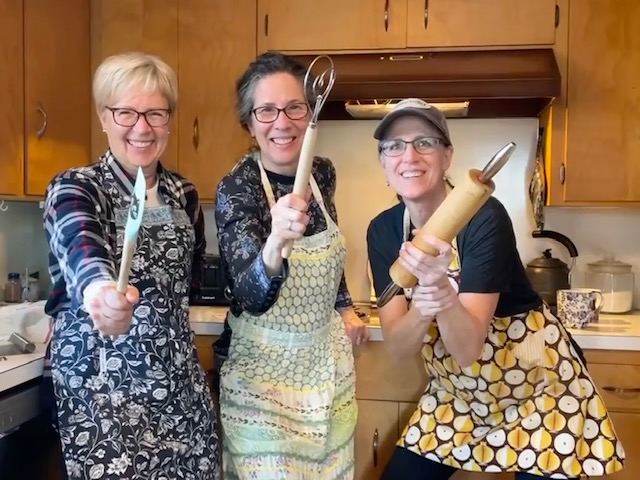
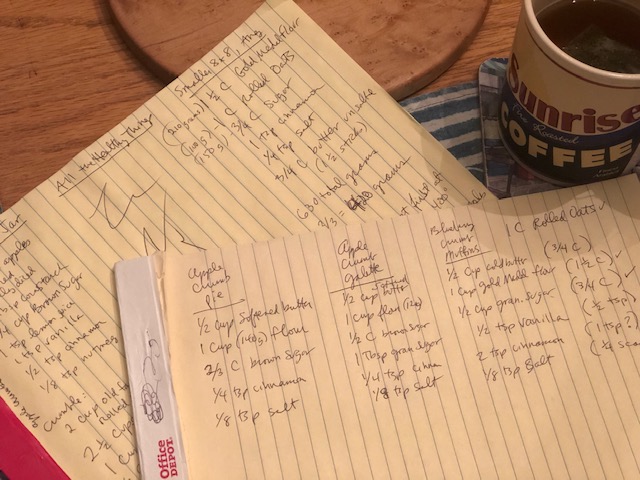
After several attempts, I think I’ve got what I’m looking for – a crunchy, slightly crumbly bottom crust, almost jam-like apple filling, and a light crumb topping. I used my crumb recipe from these Blueberry Crumb Muffins, adding in some oats. This recipe is a little fussy and time consuming (you have to make it one day in advance to do it right), but in my opinion it is well worth it.

Apple Crumb Bars

(Adapted from Ashlea Carver’s recipe)

Crust/Crumb Topping

  • 1 1/2 cups (210 grams) all-purpose flour (unbleached Gold Medal Flour* if you have it)
  • 1 cup (100 grams) oven-toasted old-fashioned rolled oats**
  • 3/4 cup (150 grams) granulated sugar
  • 1 heaping teaspoon cinnamon
  • 1/4 teaspoon kosher salt
  • 3/4 cup (1 1/2 sticks) unsalted butter, cold and cubed

Apple Filling

  • 2 good sized Gala*** apples, peeled, cored, and cut into 1/2″ cubes
  • juice of 1/2 lemon
  • 2 tablespoons granulated sugar
  • 2 dashes cinnamon
  • 1 heaping teaspoon corn starch
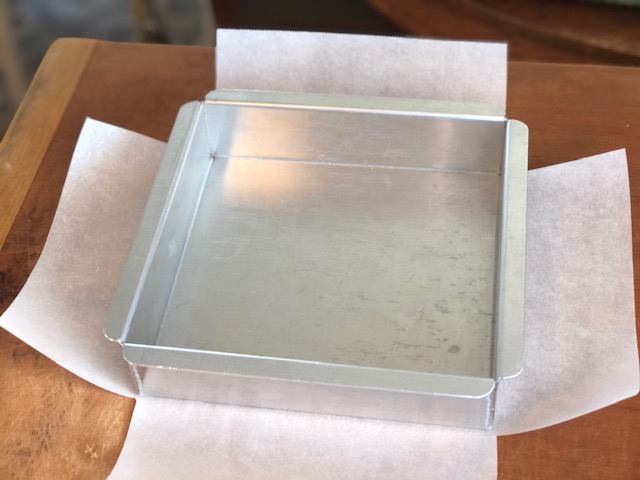
  1. Line an 8″ x 8″ square cake pan with parchment paper, making sure there is overhang for easy lifting. Set aside.
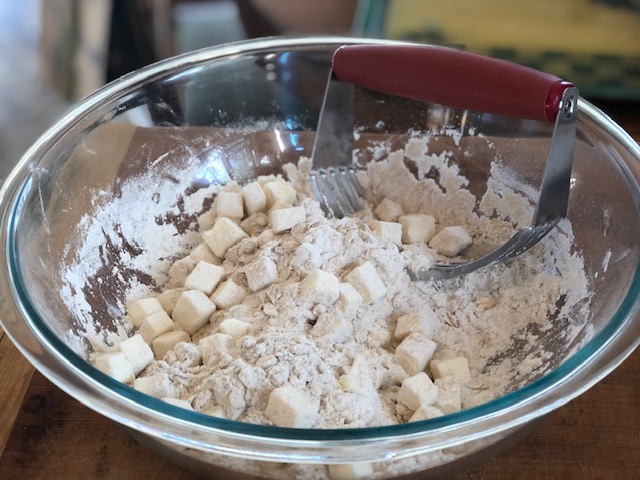
  2. In a large bowl, mix together the flour, oats, sugar, cinnamon, and salt. Cut in the cubes of butter with a pastry blender or rub it in with your fingers. Keep going until you get a sandy texture and there are no more large pieces of butter.
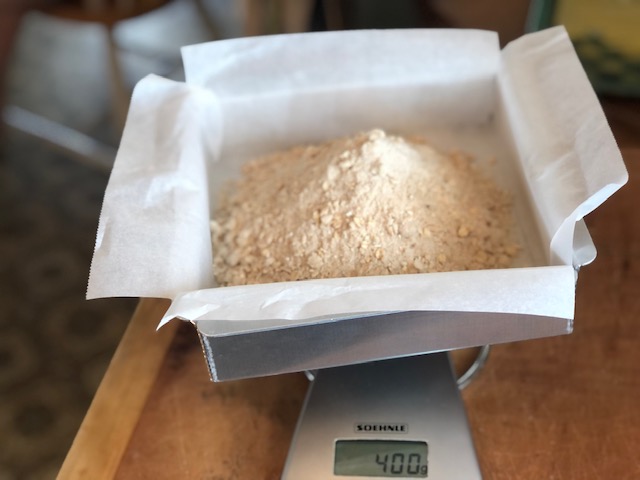
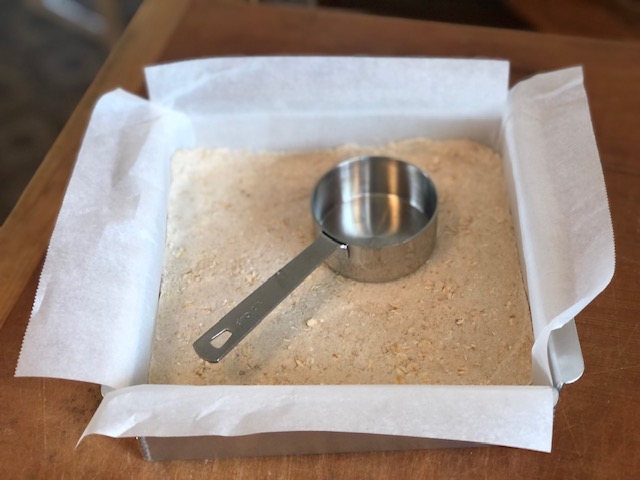
  3. Put 2/3 of the crumb mixture (about 3 cups worth, or 400 grams) into your prepared pan. Spread the crumb evenly, and press it down firmly either with your fingers or the back side of a measuring cup. Place the pan/crust into your freezer for 30 minutes. Put the remaining crumb mixture in the fridge. Go check your email or have a cup of tea.
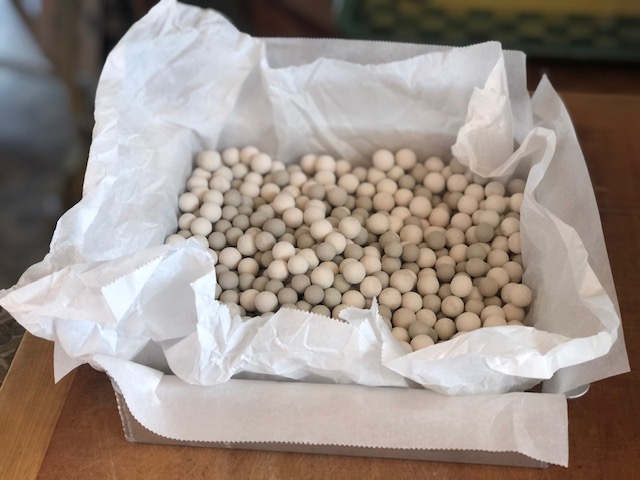
  4. About halfway through your chill time, preheat your oven to 400°. When the 30 minutes is up, remove crust from freezer and place another sheet of parchment paper on top of the chilled crust and fill it with dried beans or pie weights. Bake the crust on the middle rack of your preheated 400° oven for 15 minutes. Rotate the pan and bake for 15 minutes longer.
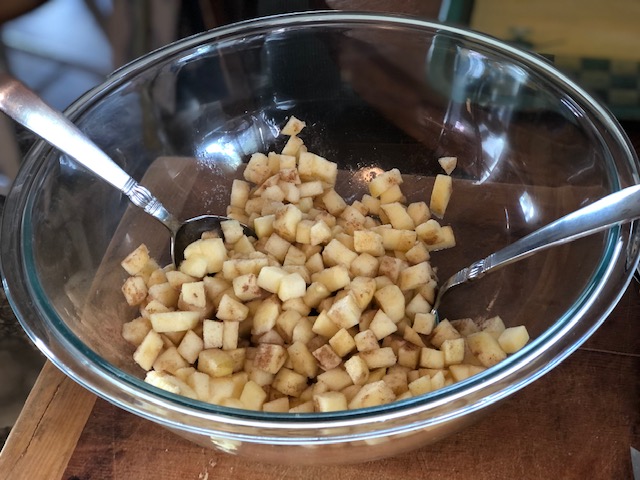
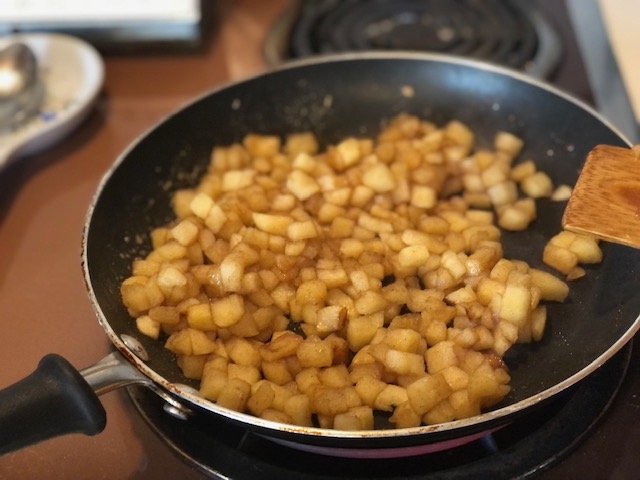
  5. While the crust is baking, peel, core and dice your apples into 1/2″ cubes. Toss with 2 tablespoons sugar and 2 dashes cinnamon. You don’t want to overdo it with the cinnamon, because you want the apples to taste like apples!
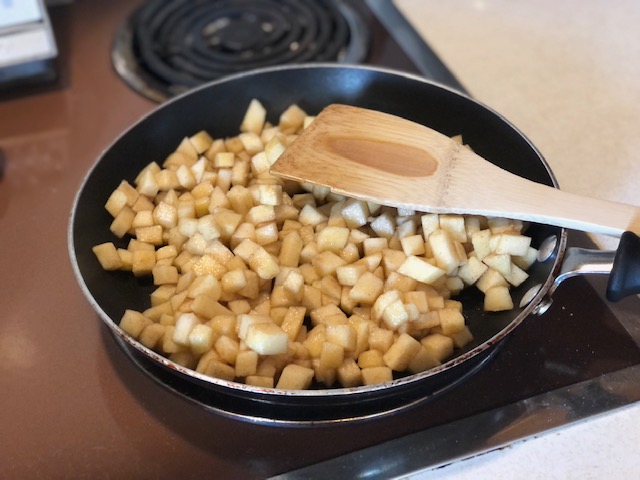
  6. In a medium (10 inch) non-stick saucepan, saute the prepared apples on medium-high heat, stirring often. You will see a lot of juice at first. Keep cooking and stirring until you no longer see any juices, and the apples have darkened. Some might even have started to caramelize. This might take 8 to 10 minutes, give or take a few. Just keep an eye on them. You don’t want them to burn!
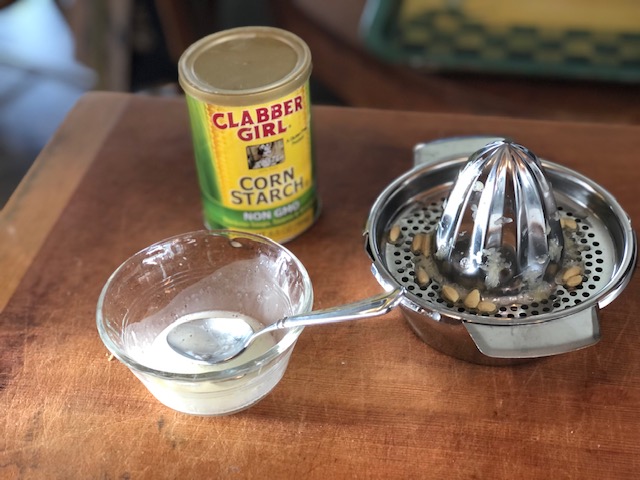
  7. Remove apples from heat. Mix a couple of teaspoons of the fresh lemon juice with the teaspoon of cornstarch. Drizzle over the hot apples and mix well. Set aside.
  8. When the crust is done baking, carefully remove the parchment paper containing the pie weights and set into a bowl. The crust should look darker, and have darkened edges. If you like a crunchier crust, you can pop it back into the oven for another 5 to 10 minutes. Remove from oven and turn the temperature down to 350°.
  9. Spread the apples evenly over the baked crust. Get the remaining crumb topping from your fridge and sprinkle evenly over the apples. There should be plenty. Beware that the pan is very hot to the touch… ask me how I know.
  10. Using oven mitts, place the pan into the 350° oven and bake for 30 minutes. After 30 minutes, turn the oven down to 200° and bake for another 30 minutes, ensuring a nice, light crumb. This also dries the apple filling a bit, which helps keep the bars from getting soggy.
  11. Remove from oven and place on cooling rack; let cool completely in the pan. Once completely cool, cover pan well with aluminum foil and place in the fridge to chill overnight.
  12. When ready to serve, remove from the pan by lifting the sides of the parchment paper. The dessert should come out easily. Cut the bars with a very sharp knife, pressing all the way down, into 16 or 25 bars, depending on how big you want them to be. These keep nicely at room temperature for several days. Enjoy!

Notes:

*I chose Gold Medal flour (unbleached) for this recipe because it is lower in protein, so it makes for a more tender crumb, but you can use any all-purpose flour you have on hand.

**I buy the oven-toasted oats from Trader Joe’s, but you can toast them yourself easily enough this way.

***I like Gala apples for this dessert, as they keep their shape nicely, and have a good flavor, which intensifies nicely when cooked down. Golden Delicious might also be nice if you can’t find Galas.

Here are some photos of the process:

Cutting the corners makes it easier to line.

Leave plenty of overhang.

Add cubes of cold butter and coat them in the flour/sugar/oat mixture.

Start cutting in the butter, you can use your fingers for this if you like.

This looks ready.

Put 2/3 of the crumb into the pan.

Spread evenly and press down firmly to make a bottom crust. Freeze for 30 minutes.

Line crust with parchment and fill with pie weights or dried beans. Bake at 400°.

After baking it might look like this. I like it a bit darker.

Prepare the apples.

Toss in sugar and cinnamon.

Cook down on medium-high heat.

This looks right.

Mix corn starch and lemon juice and mix into apples.

Spread apples evenly over baked crust, being careful of hot pan!

Sprinkle remaining 1/3 of crumb over apples and bake at 350°, then dry at 200°.

Pull out of pan once it has chilled in fridge overnight.

Cut with a sharp knife.

I just love this shot, so I had to share it with you.

Enjoy!

Posted in Cookies, Desserts, Fun in the kitchen! | 7 Comments

Tiramisu

Every holiday season I try at least one new recipe to add to my holiday repertoire. This year, it is tiramisu! I’ve been wanting to try making it for a long time now, ever since I waited tables at Café Juanita, back in the days when it was owned by Peter Dow. Tiramisu was always on the menu, and it was so very good!

I used Alison Roman’s tiramisu recipe that I found on the NYT Cooking app. It was fairly straightforward and easy – yay! But I found that it needed more of the mascarpone/whipped cream, and less soaking of the lady fingers (they get too soggy if they are over soaked). So I doubled the cream mixture and went lightly on the soaking, and found that there was too much cream and the lady fingers weren’t quite soaked enough! Seriously, it’s just a matter of taste. Both times I served the tiramisu to guests and both times everybody loved it. It’s just me being extra picky.

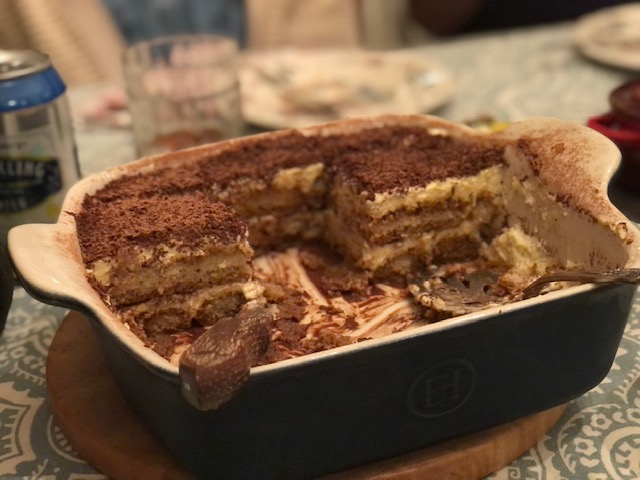
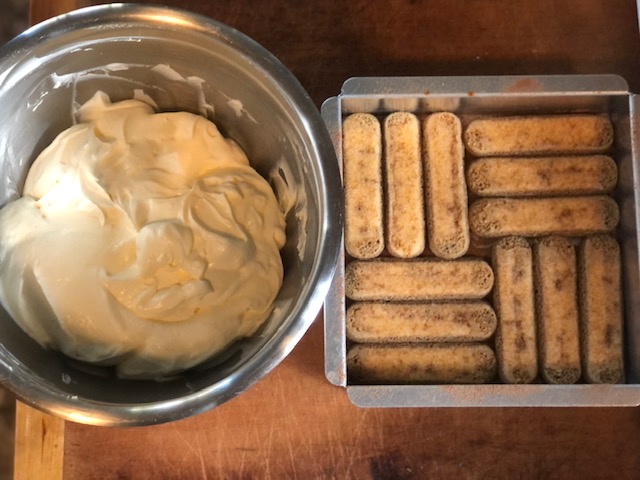
An 8″ square cake pan holds the ladyfingers perfectly!

So the third time I made it just for my family, and we had it on Christmas Eve. I increased the cream filling a bit, and hoped for the best with the soaking of the lady fingers, and it came out just how I wanted it to!

Tiramisu

(Slightly adapted from Alison Roman’s recipe)

Cream filling:

  • 4 large egg yolks
  • 1/2 cup granulated sugar, divided
  • 1 cup heavy cream
  • 1 1/2 cups mascarpone cheese at room temperature*

For assembly:

  • 1 1/2 cups espresso or strong coffee**
  • 1 tablespoon dark rum (optional)
  • 2 tablespoons unsweetened cocoa powder
  • 24 ladyfingers (one 7 ounce package Savoiardi style)
  • 1 ounce dark chocolate, shaved (optional)
  1. Make the cream filling: in a large bowl, beat the egg yolks and 1/4 cup sugar together until mixture has at least doubled and has become a pale yellow. Beat in the mascarpone cheese until well incorporated.
  2. In a medium bowl, beat the heavy cream and remaining 1/4 cup sugar until it makes soft peaks. Fold gently into the egg yolk mixture until well combined.
  3. Mix coffee and rum in a shallow bowl and set aside.
  4. Dust the bottom of an 8″ x 8″ baking dish or cake pan*** with 1 tablespoon cocoa.
  5. Dip ladyfingers lightly, one at a time, in the coffee/rum mixture, and make a single layer of them in the cake pan, rounded side up. Only use half of the ladyfingers (12), breaking some into smaller pieces to get them to fit. Cover the ladyfingers with half of the cream filling, then repeat the dipping of the remaining ladyfingers and cover with the rest of the cream. Dust with 1 tablespoon cocoa.
  6. Cover well with plastic wrap and chill in refrigerator for at least 4 hours, but really, this dessert is much better when it has chilled for 24 to 48 hours. Plan ahead for this; it’s worth it.
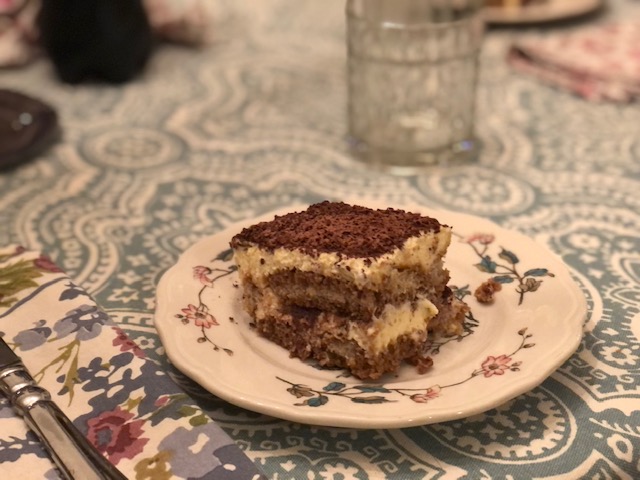
  7. When ready to serve, cut into 9 equal portions, and sprinkle each piece with shaved chocolate (optional). Enjoy!

Notes:

*If you don’t want to end up with an extra half cup of mascarpone cheese, since it usually comes in 1 cup containers, just use 2 full cups!

**I use an Italian moka pot to make a nice strong coffee; no espresso machine necessary. I also use decaf (Dancing Goats in Olympia, WA makes the best decaf ever!). Whatever you end up using, just make sure it is strong, and you enjoy the flavor.

***I like using an 8″ x  8″ cake pan because the lady fingers fit so nicely, but for a better presentation, a pretty 8 x 8 baking dish is nice too. You decide.

Posted in Desserts, Fun in the kitchen! | 5 Comments

Multigrain Sourdough Sandwich Bread

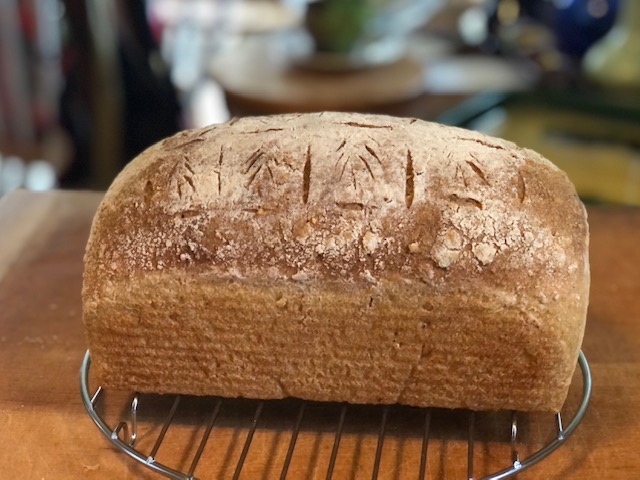
Okay, don’t panic about the pretty design on this bread; you don’t have to do that, but you can still make this very easy and delicious multigrain sourdough bread in twenty-four hours or less, from beginning to end!

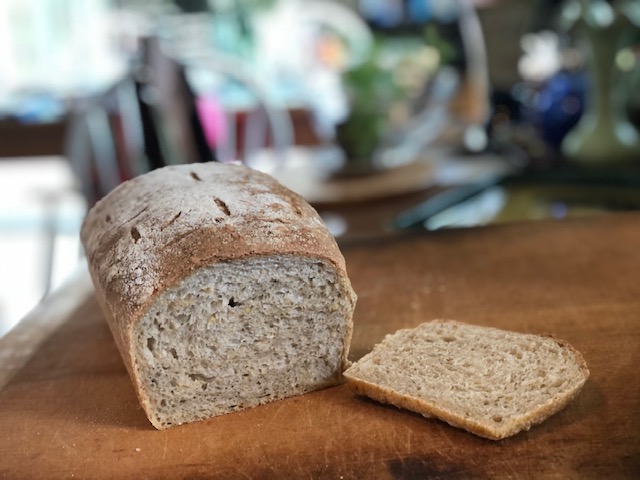
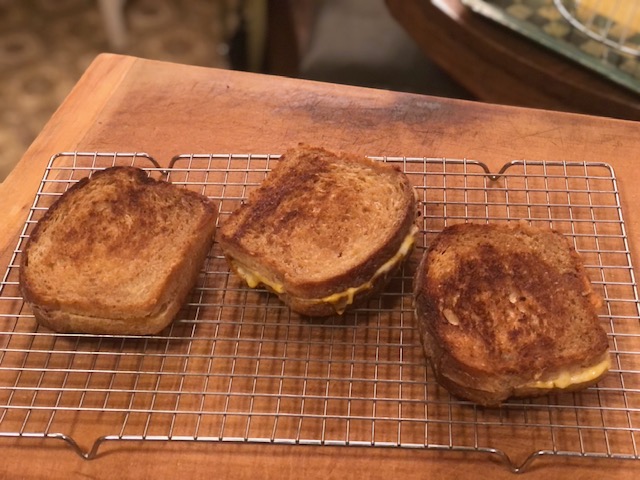
I am just a bit obsessed with this recipe. I have been playing around with quantities for a while now, as well as methods, and I’m super happy with this final result. This bread is soft and chewy and flavorful, and it stays fresh for several days. It makes the perfect PB&J, as well as amazing toast and grilled cheese sandwiches. I couldn’t be happier about it!

I originally started out with a recipe that called for soaking the grains and then pouring off the extra water. The problem with that was that it was not consistent depending on how long the grains had soaked, how well I was able to pour off the excess water, etc. And to make things more difficult, I had to then mix the soaked grains into the already prepared dough. This is a messy, sloppy business that I do not enjoy! So here is my solution: mix the grains into the starter and water mixture before adding the flour! And get this: soaking the grains is optional!! And if you do soak the grains, you only use the amount of water necessary; no pouring off! Whew. I don’t know if this is the correct method, but it works for me! The directions I am including below include pre-soaking the grains, because I think the bread is a little bit better that way.

Without the pretty design: still delicious!

Multigrain Sourdough Sandwich Bread

  • 270 grams filtered water, room temperature
  • 65 grams active, bubbly sourdough starter
  • 1 tablespoon (12 grams) sugar or honey
  • 1 tablespoon (15 grams) olive oil
  • 420 grams bread flour*
  • 30 grams whole wheat flour or whole grain spelt flour*
  • 1 1/2 teaspoon (9 grams) salt
  • 70 grams Bob’s Red Mill 8 Grain Hot Cereal*
  • 60 grams boiling water
  1. Sometime during the day, place the 8 Grain cereal into a small bowl, and mix in the 60 grams boiling water until well combined. Cover and set aside.
  2. In the evening (I do this around bedtime), in a medium sized mixing bowl, mix together the 270 grams water, 65 grams starter, tablespoon oil, and tablespoon sugar. Stir with a fork until milky and starter has been well mixed in.
  3. Add in the soaked grains and mix well.
  4. Add in the 420 grams bread flour, 30 grams whole wheat flour, and 9 grams salt, and stir until all the flour has been absorbed. Cover and let rest for 30 minutes.
  5. After the dough has rested, mix once more until dough is smooth and slightly springy. I do this by pulling the dough from the side of the bowl with a wet hand, and bringing it toward the center and pressing it in. Continue all the way around the bowl a couple of times. Flip the dough over so the smooth side is up. Cover and let rise overnight on your kitchen counter.
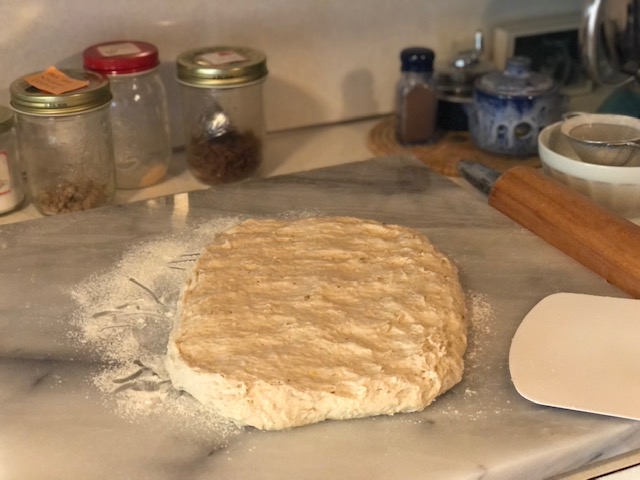
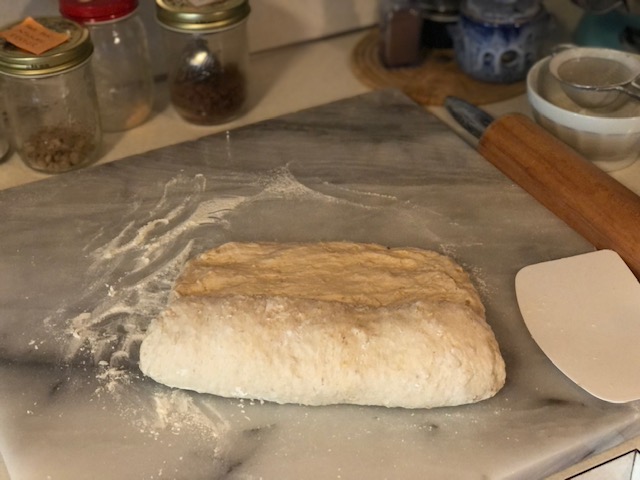
  6. In the morning, about 7 to 8 hours later for my kitchen, dough will have doubled and still be domed. (Depending on your kitchen temperature and the strength of your starter, your rise time may vary.) Scrape dough onto a floured surface. Spread it into a rectangle. Starting with a short side, bring the two corners together to make a point, then roll it up like a cinnamon roll, brushing off excess flour as you go. Tuck ends under and let rest a few minutes.
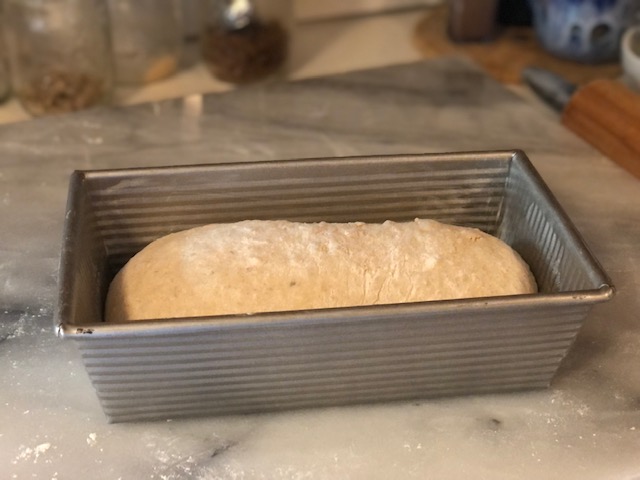
  7. While the dough is resting, butter or oil a 9″ x 5″ loaf pan (I love my USA pan loaf pan that I got from King Arthur Baking Company). It must be the 9″ x 5″ size! Place your loaf into the pan and cover (I like to use one of those food-safe shower cap type covers that I also got from King Arthur Baking Company). Let dough rise for one to two hours, until it has risen to just one inch above the rim of the pan. Don’t let it rise more than that!
  8. Preheat oven to 375°F. Uncover the dough. Optional: if you wish to make decorative cuts, sprinkle the top of the dough lightly with flour, then make very shallow cuts with a very sharp knife or razor blade in any design you like. Bake the bread on the center rack of your preheated 375° oven for approximately 45 minutes. Bread should be a golden brown color. Internal temperature should be around 205°F. Let cool in pan for ten minutes, then remove from pan and let cool completely on wire rack. This bread will slice up nicely on day #2. I hope you love it as much as I do!

Note: *I am currently using Cairnspring Mills Expresso bread flour, which is local here in the Pacific Northwest. If you are able to find a local flour, I highly recommend it! Otherwise, I have always had wonderful results using King Arthur brand flour. As far as the added grains, I love the Bob’s Red Mill brand, and they have a 7-grain, 8-grain, and 10-grain “hot cereal”.  I prefer the 8-Grain cereal because it has some larger grains in it which makes for a nice texture, but this recipe is pretty flexible, so just use whatever works for you. I find that the 10-grain requires a bit more water to soak properly than the 8-grain.

Below are some photos of the process.

First mix.

Second mix – nice and smooth!

Next morning, this is just right.

Spread it out into a rectangle.

Make a point by bringing corners together.

Start rolling it up.

Almost done.

A nice little loaf.

Plop into greased pan, seam side down.

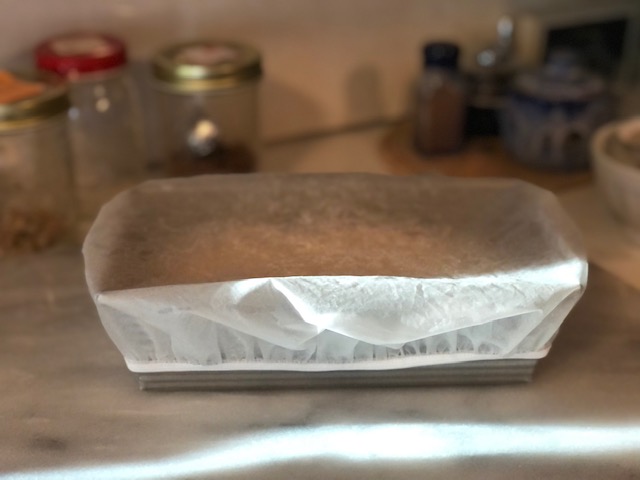
Cover. I love these reusable covers!

Ready to go! It’s not perfectly even, but that’s okay.

Posted in Breads, Breads, Sourdough | 4 Comments

Blind-Baking (prebaking) Your Pie Crust

This post is long overdue. I have tried to avoid prebaking and parbaking pie crusts for a long time. I have tried the short cuts, more than I care to mention, and I have come to the conclusion that it really is worth the trouble to prebake a pie crust for things like pumpkin pie or quiche. No soggy bottoms here.

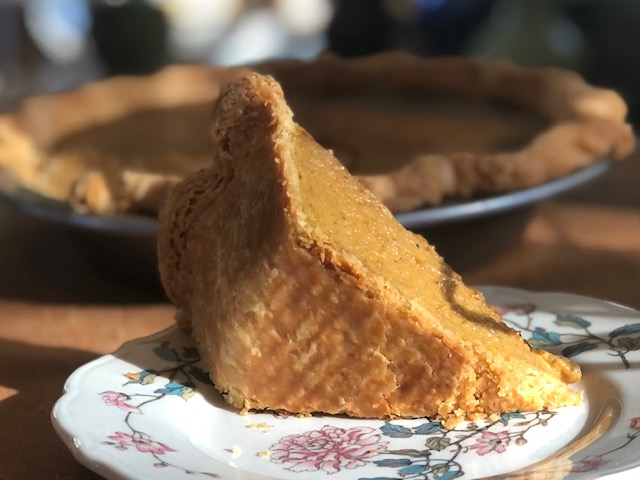
This piece of pie is turned on its side for a better view.

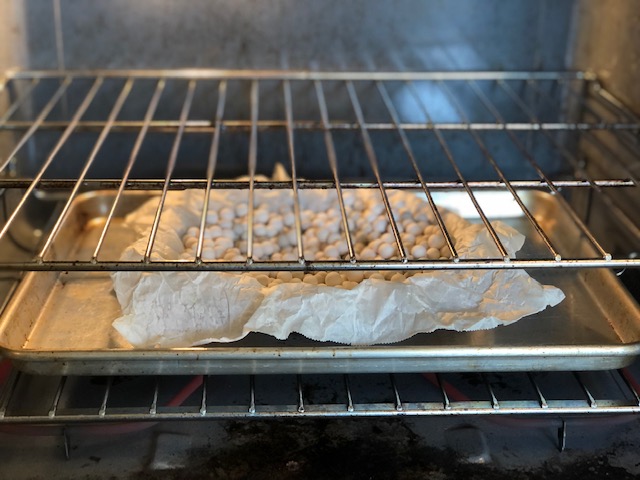
By the way, every step of the way, your pie pan should be on a cookie sheet. It makes it easier to take the crust in and out of the oven without crushing the edges, and it also helps with even baking. In the photos, the cookie sheet made a glare, so I took photos without. But for best results, use a cookie sheet under your pie pan the entire time!

What you will need to properly prebake your pie crust:

  • One homemade*, unbaked, rolled out, shaped, and crimped pie crust in pan, frozen.
  • Parchment paper or aluminum foil (I use parchment paper)
  • Cookie sheet
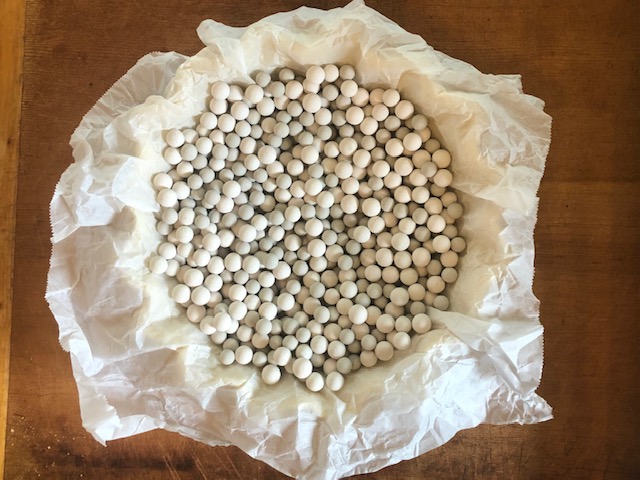
  • Pie weights, either dried beans or ceramic pie weights
  • Heatproof bowl
  • 1 egg yolk and pinch of salt

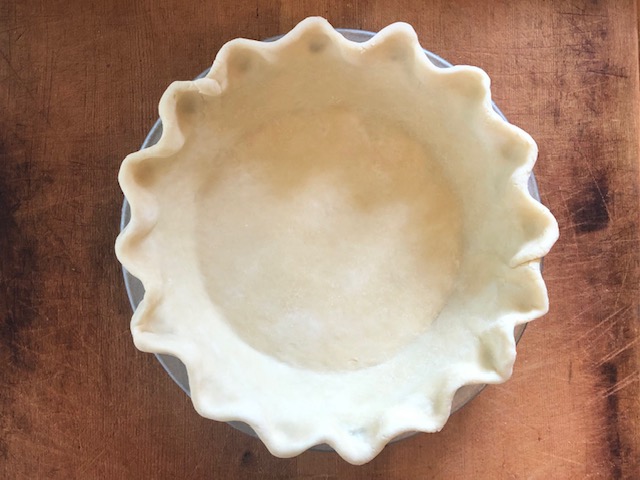
The unbaked pie crust is a work of art. If you want your pie crust to hold its shape, you will need to make it with shortening. An all-butter crust (which is what I prefer) will shrink a tiny bit, no matter how much you chill it. But chill it anyway, unless you want a disaster on your hands. And if you freeze it before baking it, you will have the most success for keeping the shape.

Note: *This method is only meant for homemade pie crusts. The frozen crusts you buy at the supermarket are not meant to be prebaked.

Pie crust is dreamy.

To blind-bake your crust, first make sure you have chilled your shaped crust in the freezer for at least 30 minutes, but a couple of hours is even better. Preheat your oven to 400°. Then you’ll want to line the frozen unbaked crust with parchment paper – I like to crumple it up first so that it fits better inside the pie shell. Make sure to cover the edges of the crust with the paper. Then fill with dried beans or pie weights. Lately I have been using ceramic pie weights and I really love them, but warning: you will need several packages of them just to barely fill a pie crust. I had them on my Christmas list last year.

Bank the pie weights up along the edges to prevent slouching.

Place your prepared pie crust on a cookie sheet and bake on the bottom rack of your 400° oven for 40 minutes, rotating the crust halfway through the bake time.

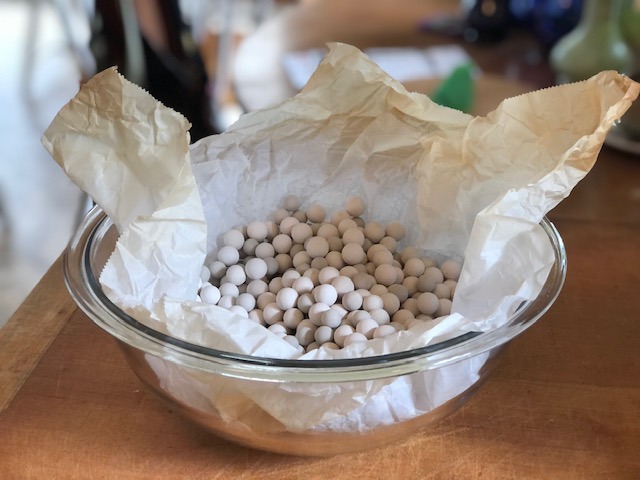
When 40 minutes is up, take pie crust out of the oven and carefully remove the parchment paper and pie weights by grabbing all four corners of the paper and lifting. Place paper and weights in a heatproof bowl.

When done prebaking, carefully put the paper and pie weights into a heatproof bowl.

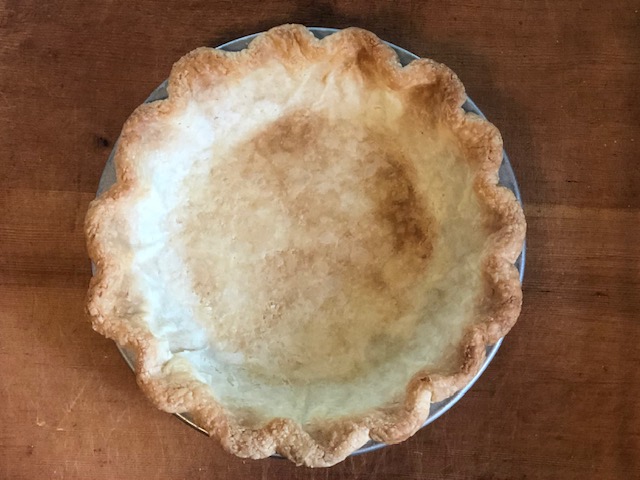
Here’s how it looks so far, but we’re not done yet!

Almost done!

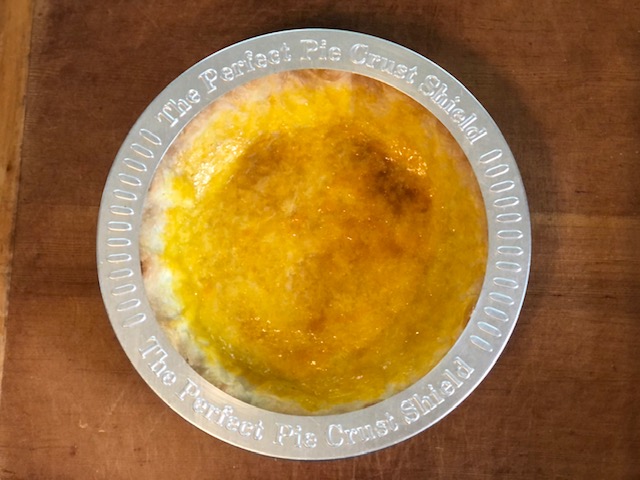
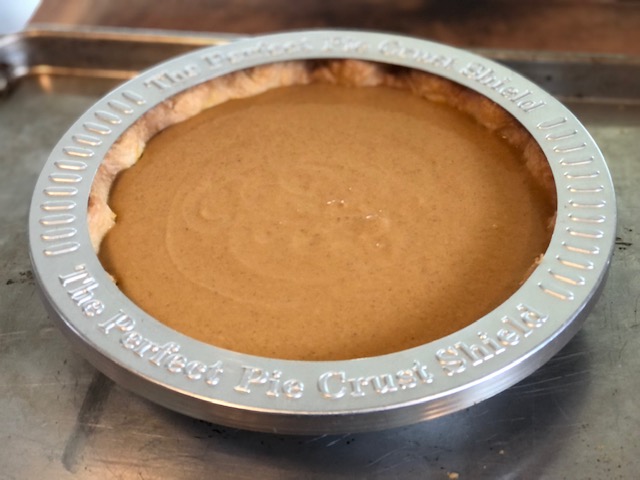
At this point, you will want to have ready an egg yolk mixed with a pinch of salt. The egg yolk will act as a barrier, protecting the crust from the wet filling. Brush the inside of the hot pie crust with the egg yolk, put a pie crust shield or foil around the edges, and put everything back in the oven for 1 minute, until the egg yolk is dry to the touch.

Egg yolk is brushed on before putting back in the oven.

After one minute in the oven, the egg yolk is now dry to the touch. This pie crust is ready to go!

Don’t worry if you think the bottom or edges are already perfectly baked and you don’t want them to bake more. When you pour the wet pumpkin pie filling or quiche filling into your crust and pop it back into the oven, the crust will not really bake any more at all. And you’ll just want to protect the edges of the pie crust with foil or a pie shield so you don’t end up with burnt edges.

This is ready to go into the oven!

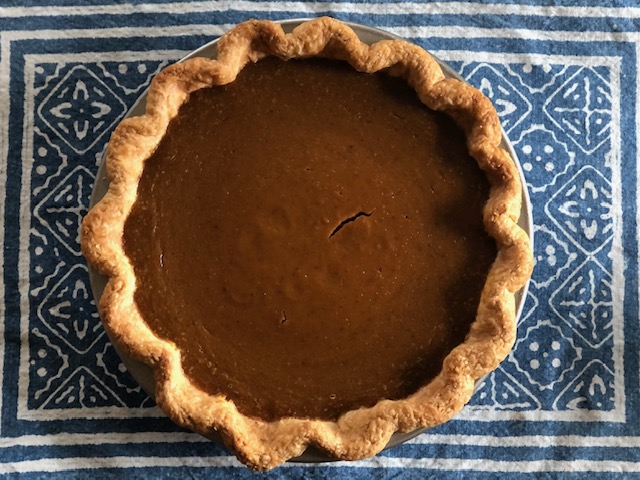
The crust on this pumpkin pie is perfectly baked, not burnt at all! And I even over baked the pie by a few minutes (notice the crack). By the way, I have updated my pumpkin pie recipe, and really love it now, just in case you are looking for a good recipe.

A perfectly baked crust!

While we are here, can we talk for a minute about a well baked crust? Think about it. When you go to a bakery and order a croissant, do you want it to be soft and pale, or do you want it to be dark golden brown, with crispy flakes that explode when you bite into it? Well, this is what I want for my pie crusts too. You can make an absolutely perfect all-butter pie dough, but if you don’t properly bake the crust, it won’t be flaky. To quote the Joy of Cooking:

“We now believe that all prebaked pastry crusts must be fully baked before filling. Defying logic, the baked shells do not burn when baked a second time with their filling, though the edge does sometimes darken – a small price to pay for a deliciously crisp and flaky crust.”

Posted in Desserts, Fun in the kitchen!, Pie! | 4 Comments